KATHMANDU: The FIFA World Cup, which began in 1930 with just 13 teams and a challenging, primitive format, has now evolved into the biggest edition in history. The tournament is currently being staged in North America, jointly hosted by the United States, Mexico, and Canada, featuring a record 48 teams in its 23rd edition.
After a 12-year break caused by the World Wars, the competition has grown steadily from 13 to 48 participating nations, reflecting nearly a century of transformation from 1930 to 2026. Throughout this journey, the World Cup has overcome many ups and downs but has consistently reached new heights, becoming the most prestigious and widely followed event in global sports.
Over its 96-year history, the tournament has produced countless legendary players whose brilliance has captivated fans around the world. Football icons such as Pelé, Diego Maradona, Franz Beckenbauer, Garrincha, George Best, Zinedine Zidane, Ronaldo, Lionel Messi, Cristiano Ronaldo, and Kylian Mbappé have all added to the magic of the World Cup, making it a true festival of football.
The 23rd edition, currently underway in North America, has just begun its group-stage matches. Not all of the 48 teams have even completed their opening games yet, while 20 matches had been played as of Wednesday morning.
However, even at this early stage, Argentina captain Lionel Messi has already made headlines by breaking several records. Goals remain the most crucial aspect of football, and recent group-stage matches in Groups I and J have significantly reshaped the all-time World Cup scoring charts, with further changes expected in this edition.
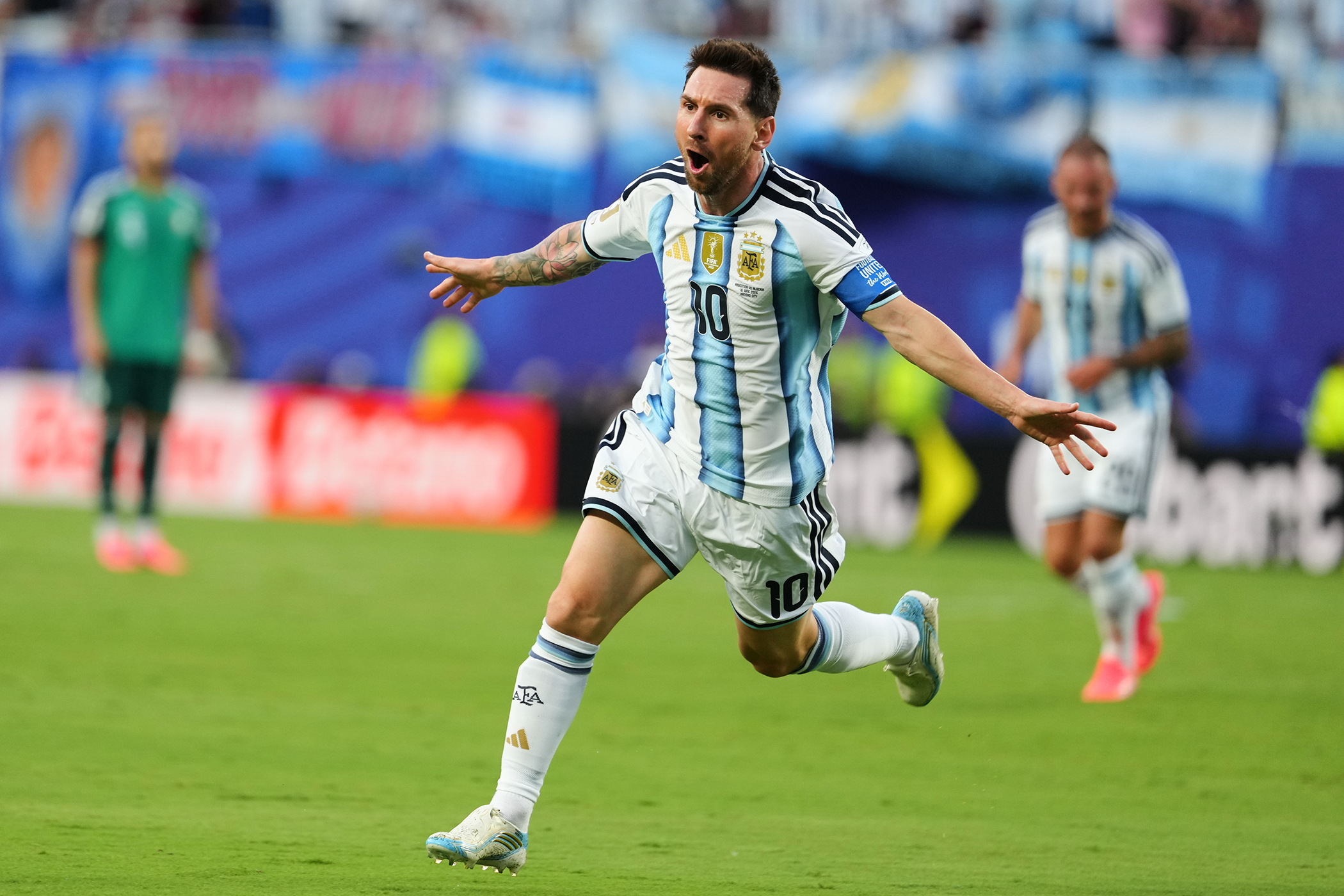
In a dominant 3–0 victory over Algeria, Lionel Messi scored a hat-trick, bringing his World Cup total to 16 goals and equaling Germany’s Miroslav Klose as the all-time top scorer in World Cup history.
Meanwhile, France’s Kylian Mbappé scored twice in a 3–1 win over Senegal, taking his World Cup tally to 14 goals. He now trails Messi and Klose by just two goals, firmly positioning himself in the race for the all-time scoring record.
Norway’s Erling Haaland also scored twice against Iraq in what was his first World Cup appearance. While he is not yet in the all-time scoring race, he has quickly emerged as a strong contender for the Golden Boot in this edition of the tournament.
FIFA World Cup All-Time Top Scorers
Miroslav Klose – Germany (16 Goals)
German striker Miroslav Klose is the highest scorer in FIFA World Cup history, having scored 16 goals across four different editions of the tournament. He achieved the feat in 24 matches.
Klose began his World Cup scoring journey at the 2002 FIFA World Cup, jointly hosted by Japan and South Korea—the first World Cup ever co-hosted by two nations and the first held in Asia. He scored five goals in that tournament and added another five at the 2006 World Cup on home soil. He netted four goals in South Africa 2010 before scoring twice at Brazil 2014, surpassing Ronaldo’s long-standing record of 15 World Cup goals.
Lionel Messi – Argentina (16 Goals)
Argentine captain Lionel Messi is regarded as one of the greatest footballers in history. Appearing in his sixth World Cup, Messi owns numerous tournament records.
He joined Klose at the top of the all-time scoring chart with 16 goals after scoring a hat-trick in Argentina’s 3–1 victory over Algeria on Wednesday. Having played only one match at the ongoing 2026 World Cup, Messi began his World Cup scoring record at Germany 2006.
He scored:
- 1 goal in Germany 2006
- 0 goals in South Africa 2010
- 4 goals in Brazil 2014
- 1 goal in Russia 2018
- 7 goals in Qatar 2022
- 3 goals so far at the 2026 World Cup
Messi has also played a record 27 World Cup matches.
Ronaldo – Brazil (15 Goals)
Ronaldo, one of the greatest strikers of his generation, played a pivotal role in Brazil’s triumph at the 2002 FIFA World Cup.
He scored eight goals in the tournament hosted by Japan and South Korea, the first World Cup held in Asia. Across four World Cup appearances, Ronaldo scored 15 goals in 19 matches. His all-time scoring record, set in 2006, stood until Klose surpassed it at Brazil 2014.
Ronaldo’s World Cup goal tally:
- 0 goals in USA 1994
- 4 goals in France 1998
- 8 goals in Korea/Japan 2002
- 3 goals in Germany 2006
Gerd Müller – West Germany (14 Goals)
West German legend Gerd Müller needed only two World Cups and 13 matches to score 14 goals, underlining his extraordinary efficiency as a striker.
He scored an incredible 10 goals at the 1970 World Cup in Mexico and added four more when West Germany hosted the tournament in 1974.
Kylian Mbappé – France (14 Goals)
Kylian Mbappé is among the most electrifying strikers of the modern era. He inspired France to win the 2018 World Cup in Russia and reach the final in Qatar 2022.
Despite Mbappé’s hat-trick in the 2022 final, France fell short as Messi’s Argentina lifted the trophy.
The 2026 World Cup marks Mbappé’s third appearance at the tournament. He has played only France’s opening group-stage match so far, scoring twice in a 3–1 victory over Senegal. His World Cup record now stands at 14 goals in 15 matches, making him one of the leading contenders for the Golden Boot and second only to Messi among active players on the all-time scoring list.
His World Cup goals:
- 4 goals in Russia 2018
- 8 goals in Qatar 2022
- 2 goals so far in 2026
Just Fontaine – France (13 Goals)
Just Fontaine holds one of the most remarkable records in World Cup history. He played only one World Cup—the 1958 tournament in Sweden—but scored an astonishing 13 goals in just six matches.
His scoring rate exceeded two goals per game, and he finished as the tournament’s Golden Boot winner.
Pelé – Brazil (12 Goals)
Widely known as the “King of Football,” Pelé remains one of the greatest players ever to play the game.
He inspired Brazil to World Cup titles in 1958, 1962, and 1970. Across four World Cup editions, Pelé scored 12 goals in 14 matches.
His World Cup goals:
- 6 goals in 1958
- 1 goal in 1962
- 1 goal in 1966
- 4 goals in 1970
Many of Pelé’s World Cup records remain intact to this day.
Jürgen Klinsmann – Germany (11 Goals)
Former German captain Jürgen Klinsmann scored 11 goals in 17 World Cup matches across three tournaments.
He began scoring at the 1990 World Cup and maintained his scoring form through France 1998.
His World Cup goals:
- 3 goals in 1990
- 5 goals in 1994
- 3 goals in 1998
Sándor Kocsis – Hungary (11 Goals)
Sándor Kocsis is another player whose World Cup scoring rate exceeded two goals per match.
He appeared in only one World Cup—the 1954 tournament—and scored 11 goals in just five matches, making him one of the most prolific scorers in the competition’s history.
Several football legends share notable places in World Cup history with remarkable goal records, while a new generation continues to chase the all-time charts.
Former Argentina striker Gabriel Batistuta, Peru’s Teófilo Cubillas, Poland’s Grzegorz Lato, England’s Gary Lineker, Germany’s Thomas Müller, and West Germany’s Helmut Rahn all scored 10 World Cup goals each before retiring from international football.
A group of iconic players sits just behind them with nine goals, including Brazil’s Ademir, Jairzinho and Vavá, Italy’s Roberto Baggio, Paolo Rossi and Christian Vieri, West Germany’s Karl-Heinz Rummenigge and Uwe Seeler, Portugal’s Eusébio, and Spain’s David Villa. All of them have also ended their careers.
In the current all-time race, alongside Lionel Messi and Kylian Mbappé, several active stars are still in contention, including England captain Harry Kane, Brazil’s Neymar, Portugal’s Cristiano Ronaldo, Ecuador’s Enner Valencia, and Colombia’s James Rodríguez.
Kane, Neymar, and Ronaldo currently have 8 World Cup goals each, while Valencia and James Rodríguez have 6 each. England are set to begin their campaign against Croatia, while Portugal face Congo in their opening match.
Brazil opened their World Cup campaign with a disappointing 1–1 draw against Morocco, where Neymar failed to score. Ecuador suffered a 1–0 defeat against Ivory Coast, while Colombia will begin their 2026 World Cup journey against Uzbekistan.