Rights groups warn ban on student unions would undermine democracy
Speaking at an interaction program in Kathmandu, participants warned that such a move would mark the first step toward “elected authoritarianism.”

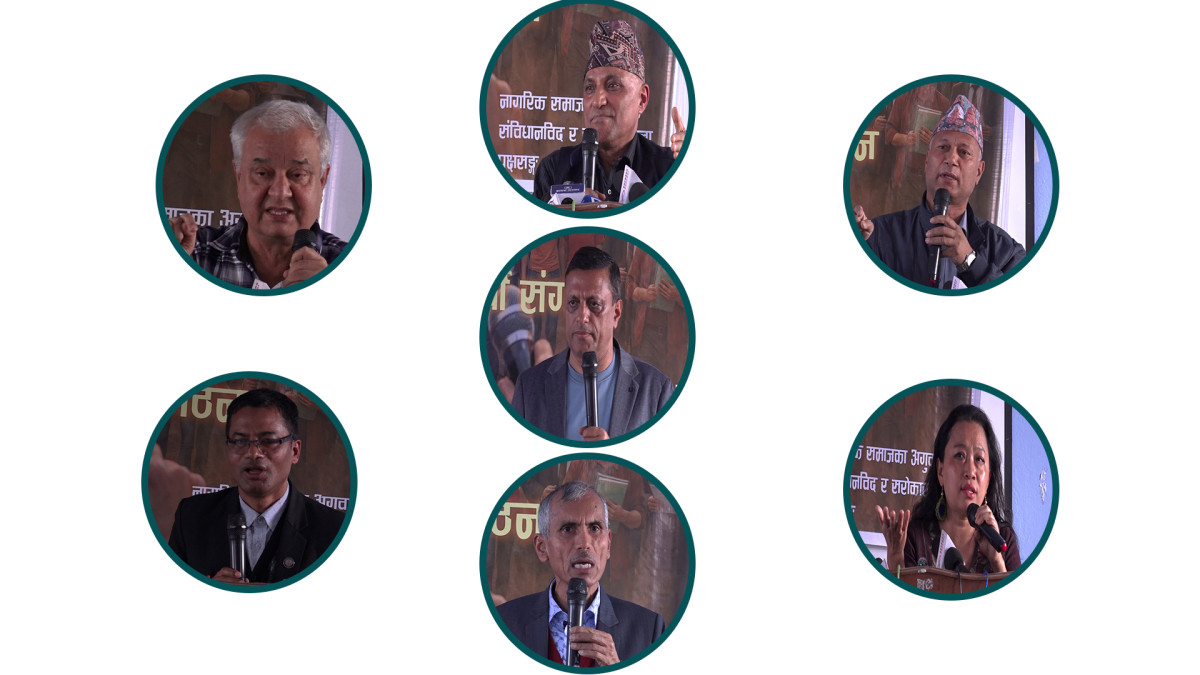
KATHMANDU: Legal experts, rights activists and civil society leaders have strongly criticized the government’s reported plan to ban student organizations, calling it a direct assault on constitutional freedoms, multiparty democracy and established democratic practices.
Speaking at an interaction program in Kathmandu, participants warned that such a move would mark the first step toward “elected authoritarianism.” They argued that banning student unions affiliated with political parties would violate the constitutional right to freedom of association and contradict international human rights commitments, potentially destabilizing the country’s political system.
Senior advocate Tikaram Bhattarai described the proposal as a “serious attack” on the constitution, democratic movements and parliamentary traditions. He stressed that the constitution clearly guarantees the right to form organizations and hold political beliefs, adding that no elected prime minister has the authority to impose an outright ban on such groups.
“Only under exceptional circumstances—such as threats to national sovereignty or territorial integrity—can activities be restricted through proper legislation,” he said. “Dissolving organizations through verbal orders or executive fiat is unconstitutional.”
Bhattarai also urged the government to make public the identities of those involved in acts of vandalism, including attacks on key state institutions such as Singha Durbar, the Presidential residence and the Supreme Court.
Another senior advocate, Ekaraj Bhandari, warned that the move could backfire on the government itself. He reminded officials that the current leadership rose to power on the strength of student movements, cautioning them not to forget their roots.
“Banning student organizations to curb irregularities in universities is misguided,” he said. “Instead, the government should reform laws to ensure transparency in appointments and strengthen good governance. Anti-corruption efforts must begin within the government itself.”
AI expert Doman Rai expressed concern over what he described as the growing risk of “elected dictatorship,” arguing that it could be more dangerous than unelected authoritarianism. He cautioned that the state could end up mobilizing students against fellow citizens, creating deeper social divisions.
Former president of the Nepal Bar Association, Sher Bahadur KC, echoed these concerns, warning that such a ban would push the country back toward authoritarian rule. He noted that even during the Panchayat era, student organizations retained legal recognition.
Similarly, legal professionals and leaders from various organizations emphasized that the right to form associations is a fundamental human and constitutional right. They warned that restricting student unions could erode hard-won democratic gains and weaken the broader political system.
Padam Rokaya, president of the Nepal Lawyers Association, said banning student organizations would violate both the right to life and the right to live with dignity. “If citizens are denied the freedom to organize and express themselves politically, the very foundation of a dignified life collapses,” he said.
Teacher movement leader Gunaraj Lohani went further, describing the government’s approach as a “practice of fascism.” He argued that student organizations have historically played a decisive role in major political movements—from the anti-Rana struggle to protests against the Panchayat system and King Gyanendra Shah.
“Attempting to legally suppress these organizations is a rehearsal for authoritarianism,” Lohani said. “An environment is being created where people cannot freely express themselves—even on social media. This must be resisted through both street protests and digital platforms.”
Speakers concluded by urging the government to reconsider its approach, warning that any attempt to ban student organizations would not only undermine democratic norms but also risk triggering widespread political and social backlash.