Elections must be policy-driven, not money-driven: Acting Chief Commissioner
Speaking at an interaction program with representatives of political parties on election expense management and women’s participation, Bhandari stressed that all stakeholders must act with integrity to ensure elections are free, fair, and transparent.

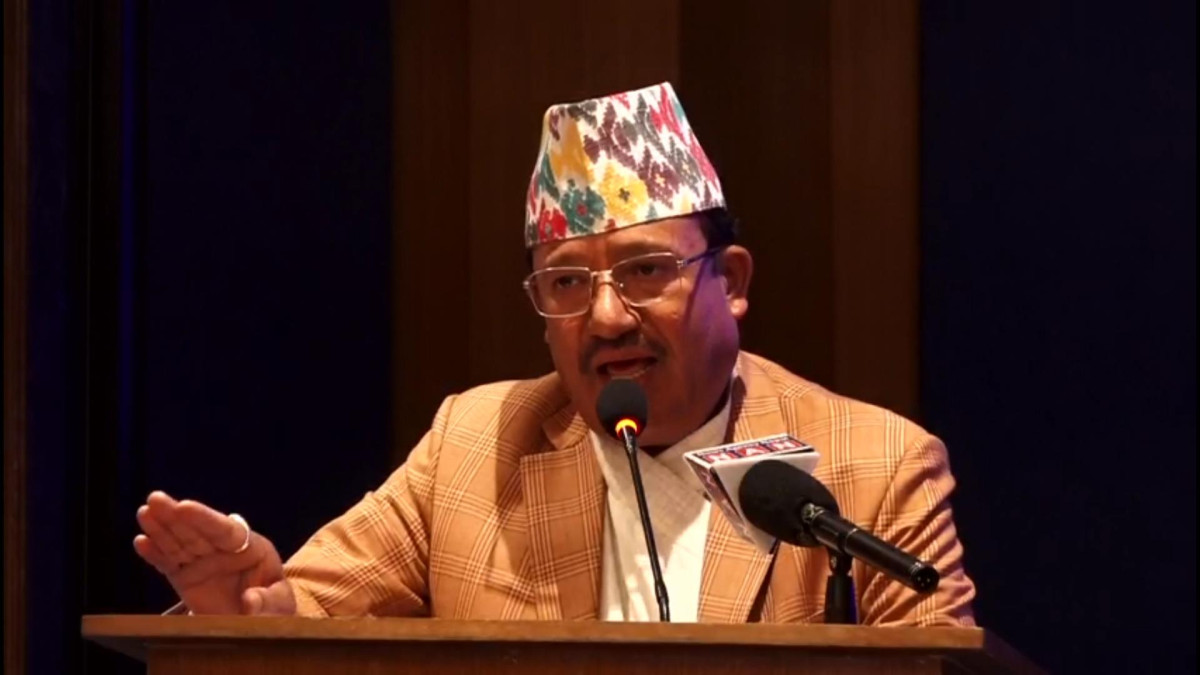
KATHMANDU: Acting Chief Election Commissioner Ram Prasad Bhandari has raised serious concerns over the rising election expenditures and the increasing commercialization of Nepal’s political process.
Speaking at an interaction program with representatives of political parties on election expense management and women’s participation, Bhandari stressed that all stakeholders must act with integrity to ensure elections are free, fair, and transparent.
Bhandari traced the influence of money in Nepalese politics back to history, citing that the problem is not new.
Referencing the autobiography of Nawaraj Subedi, he highlighted that commercialization in politics began during the 2036, when former Prime Minister Surya Bahadur Thapa granted certain businessmen permission to trade in snake skins, marking early intersections of business and politics. “Since then, every election has witnessed escalating expenses, which is not a healthy sign for democracy,” Bhandari said.
From “2 Rupees Politics” to “6 Crores Campaigns”
The commissioner compared past elections with today’s expensive campaigns. In the 2043 Rastriya Panchayat election, candidates relied on grassroots support rather than money.
He recalled how Rupchandra Bista from Makwanpur successfully ran his campaign asking voters, “If you vote for me, give me 2 rupees,” and won without lavish spending. Today, candidates often claim they cannot contest elections without spending six crore rupees, reflecting a stark imbalance and undermining the principles of clean politics.
Banking System and Adherence to Election Code
To ensure transparency, Bhandari emphasized the mandatory use of banking channels for election expenses, encouraging candidates to spend only “white money.” He acknowledged concerns that some candidates cannot afford bank accounts but insisted the step was necessary to curb the use of illicit funds.
He clarified that the recently issued 63-point directive and code of conduct are reminders for political parties, not instruments of pressure. “We have drafted these codes based on parties’ suggestions. Yet sometimes, leaders expect leniency while criticizing the commission’s strict enforcement,” he noted.
Call for a Unified Election Management Act
Bhandari admitted that multiple legal frameworks complicate election management. Currently, over ten separate acts govern elections, creating procedural challenges.
The commission had submitted a draft of a unified “Election Management Act” two and a half years ago, which has not yet been enacted by the government or parliament. “Had this act been implemented, many current issues could have been avoided,” he said.
Elections as a Tool for Social Harmony
Describing elections as the only mechanism to restore discipline and order in society, Bhandari appealed to political forces to maintain fair competition and refrain from provocative spending.
He warned that if elections fail to select proper representatives, unrest could arise. “All stakeholders must encourage candidates and party workers to exercise financial prudence and prevent politics from turning into a commercial enterprise,” he urged.
Women’s Participation: Promise vs. Practice
Bhandari criticized political parties for demonstrating a double standard in women’s participation.
While parties pledge to allocate up to 50% of seats to women in discussions with the commission, in practice, they often limit it to 33% or rely on familial networks rather than open competition.
Zero Tolerance for Code Violations
The commission will adopt a strict zero-tolerance approach toward violations of the election code.
Bhandari warned that any infringement will result in decisive action based on objective evidence, emphasizing a results-oriented and punishment-focused strategy.
Addressing Social Media Concerns
Responding to online outrage over a performance by US soldiers at Tundikhel during the Nepal Army Day, Bhandari explained that such activities are part of international training and diplomatic exchanges.
He urged citizens and political leaders to verify facts before reacting to social media rumors. “Just as our army chief may receive honorary recognition in India and our Prime Minister attends China’s Army Day, such events are standard diplomatic and friendly practices,” he said.
Commitment to Cost-Effective Elections
Bhandari reaffirmed the commission’s dedication to minimizing unnecessary election spending, noting that despite limited legal authority, the commission is prepared to fulfill its responsibilities effectively.
He also called on observers to maintain impartiality and remain cautious of biased “soft monitoring.”