World Cup 2026: Can history be broken or will it repeat itself? A complete analysis

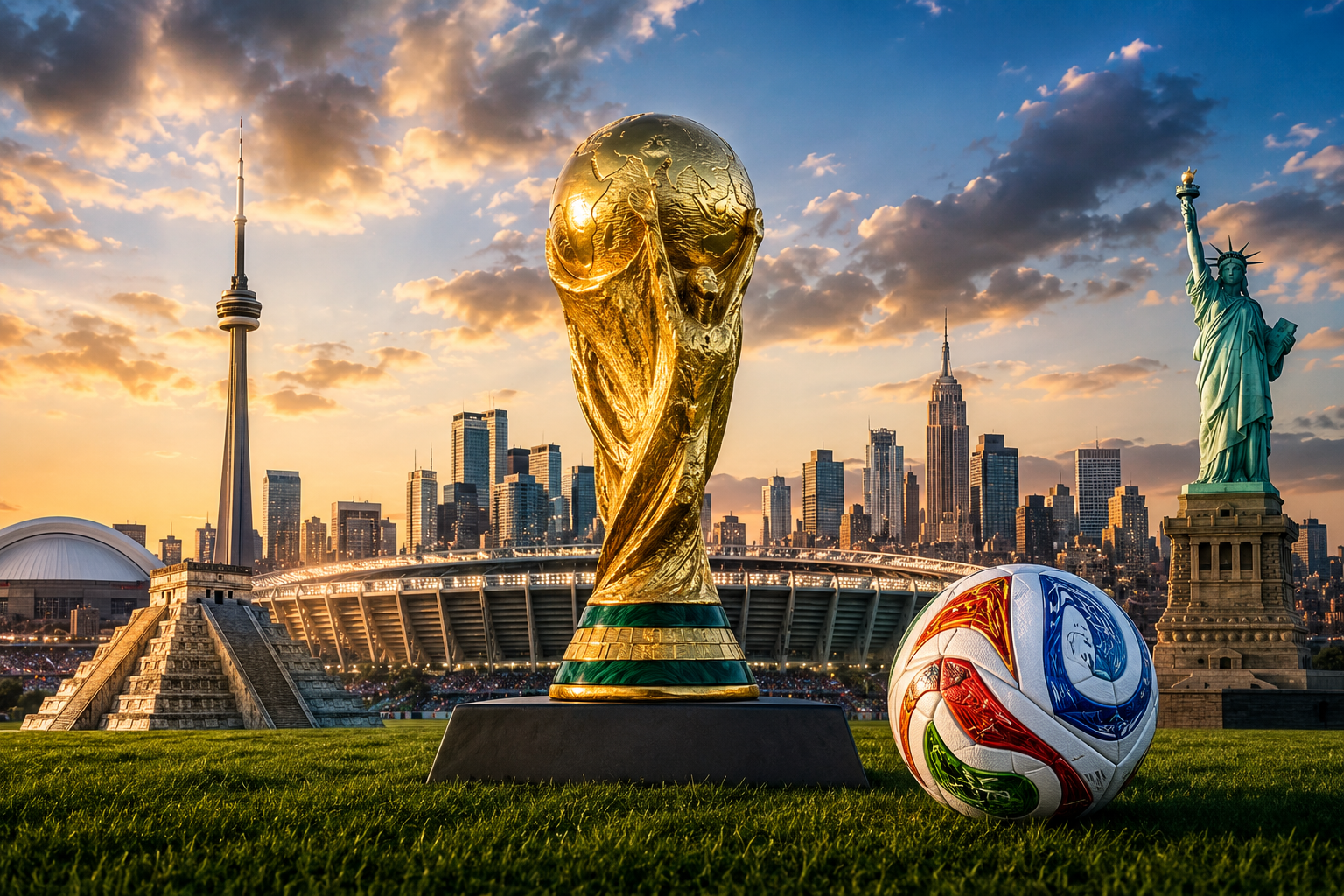
KATHMANDU: The ultimate question dominating the minds of football enthusiasts across the globe has finally taken center stage: Who will lift the iconic trophy? The answer has begun to unravel as the expanded FIFA World Cup bursts into life across Mexico, Canada, and the United States.
With the tournament expanding from 32 to 48 nations, the sheer scale of the competition has grown by half. For many supporters, several of these newly introduced competitors remain completely unknown packages.
Football is a sport defined by its beautiful unpredictability—a 90-minute arena where absolute underdogs can systematically dismantle global powerhouses.
A History of Giant-Killings and Heartbreak
The rich tapestry of World Cup history is littered with stunning upsets. Four-time champions Italy, despite consistently operating at the highest echelons of international football, have shockingly failed to qualify for their third consecutive tournament.
Memories also linger of 2002, when a star-studded French side, entering as the 1998 champions, were left utterly stunned in the opening match by a disciplined, lesser-known Senegal team. Fast forward to the previous edition in Qatar, where Argentina ultimately claimed the crown after a breathtaking, nerve-shredding final against France that went all the way to a penalty shootout. Yet, even that triumphant Argentine campaign began with one of the greatest shocks in sports history: Lionel Messi’s side falling to an opening-match defeat against Saudi Arabia.
These instances serve as a stark reminder that football defies easy predictions.
The Statistical Coincidence Eliminating the Elite
Despite the volatile nature of the sport, historians and analysts routinely look to historical data and structural trends to map out prospective champions. By analyzing one particular, unbroken historical anomaly, it is possible to confidently rule out 30 teams before the group stage even finds its rhythm.
In the 22 editions of the World Cup played since 1930, no nation has ever won the tournament under the guidance of a foreign manager. Every single world champion has been led by a tactician of their own nationality.
This historic trend directly threatens the ambitions of three primary heavyweights who are widely considered massive favorites by fans and bookmakers alike:
-
Brazil: The five-time champions are being led into this campaign by legendary Italian manager Carlo Ancelotti.
-
England: The birthplace of modern club football is looking to end its decades of hurt under the stewardship of German tactician Thomas Tuchel.
-
Portugal: Cristiano Ronaldo’s international side is being marshalled by Spanish manager Roberto Martínez.
Because they are employing foreign technical leadership, history suggests that these three giants, alongside 27 other nations, are statistically locked out of the trophy.
Decades of Perfect National Alignment
A retrospective look at the 22 previous World Cup triumphs reinforces the staggering weight of this trend.
When Uruguay claimed the inaugural tournament in 1930, they did so under the native Alberto Suppici. When they repeated the feat in the famous 1950 tournament, countryman Juan López Fontana was at the helm.
Brazil’s record-breaking five titles were delivered by five entirely different, homegrown managers:
-
1958: Vicente Feola
-
1962: Aymoré Moreira
-
1970: Mário Zagallo
-
1994: Carlos Alberto Parreira
-
2002: Luiz Felipe Scolari
Germany’s four triumphs were orchestrated by four separate German masterminds: Sepp Herberger (1954), Helmut Schön (1974), Franz Beckenbauer (1990), and Joachim Löw (2014).
Italy’s historical success follows the exact same script. Vittorio Pozzo remains the only manager to win consecutive titles, guiding his native country in 1934 and 1938. Enzo Bearzot secured the crown in 1982, and Marcello Lippi replicated the achievement in 2006. While the Italian national team is absent from North America, three Italian managers are present, leading foreign nations.
The defending champions, Argentina, secured their third star in Qatar under the guidance of Lionel Scaloni, who returns to the touchline for this campaign. Their previous titles were also homegrown achievements, masterminded by César Luis Menotti in 1978 and Carlos Bilardo in 1986.
France achieved glory in 1998 with Aimé Jacquet and again in 2018 with Didier Deschamps, who continues to lead the Les Bleus squad in the United States. England’s solitary triumph in 1966 was delivered by Alf Ramsey, and Spain’s golden generation of 2010 was steered to victory by Vicente del Bosque.
The 30 Nations Sidelined by Tradition
If this historic managerial paradigm holds true, the following 30 nations cannot win the World Cup due to their foreign coaching appointments:
-
The European and South American Giants: Brazil (led by Italy’s Carlo Ancelotti), England (led by Germany’s Thomas Tuchel), Portugal (led by Spain’s Roberto Martínez), Colombia (led by Argentina’s Néstor Lorenzo), Ecuador (led by Argentina’s Sebastián Beccacece), Paraguay (led by Argentina’s Gustavo Alfaro), Uruguay (led by Argentina’s Marcelo Bielsa), Austria (led by Germany’s Ralf Rangnick), Belgium (led by France’s Rudi Garcia), Sweden (led by England’s Graham Potter), and Turkey (led by Italy’s Vincenzo Montella).
-
The North American Hosts and Contenders: The United States (led by Argentina’s Mauricio Pochettino), Canada (led by America’s Jesse Marsch), Panama (led by Denmark’s Thomas Christensen), and Haiti (led by France’s Sébastien Migné).
-
The African and Asian Challengers: Qatar (led by Spain’s Julen Lopetegui), Saudi Arabia (led by Germany’s Georgios Donis), Iraq (led by Australia’s Graham Arnold), Jordan (led by Morocco’s Jamal Sellami), Uzbekistan (led by Italy’s Fabio Cannavaro), Algeria (led by Bosnia’s Vladimir Petković), Congo (led by France’s Sébastien Desabre), Ivory Coast (led by France’s Emerse Faé), Ghana (led by Portugal’s Carlos Queiroz), Morocco (led by Belgium’s Mohamed Ouabi), South Africa (led by Belgium’s Hugo Broos), Tunisia (led by France’s Sabri Lamouchi), Curaçao (led by the Netherlands’ Dick Advocaat), and New Zealand (led by England’s Darren Bazeley).
The 18 True Contenders
By mathematically narrowing the field through the lens of history, the list of potential winners shrinks to just 18 nations who have trusted their tactical fortunes to homegrown managers.
Among these 18, a select group of traditional elite powerhouses stand out as the genuine, historically backed favorites to claim the crown:
-
Argentina: Armed with defending champion Lionel Scaloni.
-
France: Led by the highly experienced Didier Deschamps.
-
Germany: Navigated by tactical innovator Julian Nagelsmann.
-
Spain: Orchestrated by Luis de la Fuente.
-
The Netherlands: Guided by veteran international Ronald Koeman.
-
Switzerland: Led by Murat Yakin.
The remaining homegrown contingents looking to shatter expectations and keep the managerial tradition alive include:
-
From Asia and Oceania: Australia (Tony Popovic), Iran (Amir Ghalenoei), Japan (Hajime Moriyasu), and South Korea (Hong Myung-bo).
-
From Africa: Cape Verde (Bubista), Egypt (Hossam Hassan), and Senegal (Pape Thiaw).
-
From the Americas: Mexico (Javier Aguirre).
-
From Europe: Bosnia and Herzegovina (Sergej Barbarez), Croatia (Zlatko Dalić), the Czech Republic (Miroslav Koubek), Norway (Ståle Solbakken), and Scotland (Steve Clarke).