Where cricket meets change: Women rising strong
Confined within the four walls of their homes, bound to household chores and dictated by rigid traditional roles, the country’s daughters faced an uphill battle to even dream of a career in sports.

KATHMANDU: There was a time when the mere sight of a young girl stepping onto a cricket pitch in Nepal was met with fierce resistance.
Confined within the four walls of their homes, bound to household chores and dictated by rigid traditional roles, the country’s daughters faced an uphill battle to even dream of a career in sports.
A national jersey was an unimaginable luxury.
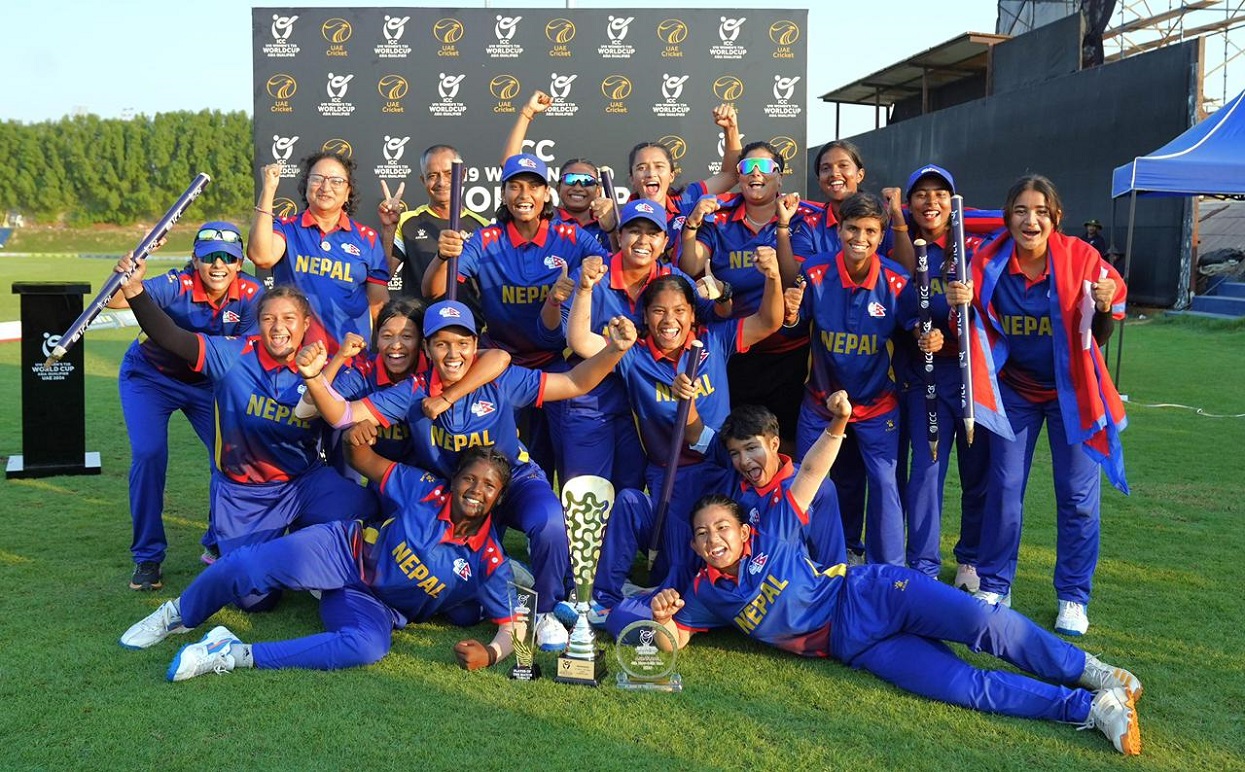
Today, that narrative is being completely rewritten. Drawing inspiration from Nelson Mandela’s famous words—that sports have the power to change the world and create hope where there is only despair—Nepali women’s cricket is scripting a historic tale of transformation.
The very hands that were once expected to remain limited to the kitchen are now confidently wielding cricket bats, delivering lethal bowling spells, and hoisting the national flag on the international stage.
This remarkable evolution is far more than a sporting triumph; it has become a powerful vehicle for women’s empowerment, as mirrored in the lives of the players themselves.
From Accidental Beginnings to National Identity
For Rachana Chaudhary, a rising star in the national setup, the journey into cricket was entirely accidental. Hailing from Subarnapur in the far-western district of Kailali, Chaudhary moved to Pokhara with her father to pursue her education. Now a Grade 12 student, she first encountered the sport at the age of 14 through the Kidasha Foundation.
“At the time, I enjoyed playing more than studying,” Chaudhary recalls. “What started as pure fun eventually gave me my identity. Later, cricket became my entire life.”
Raised by a father who worked tirelessly as a laborer, Chaudhary never imagined the sport would alter her destiny. However, her relentless practice and unwavering dedication eventually propelled her into the national team. Today, she is centrally contracted with the Cricket Association of Nepal (CAN) and counts representing Nepal at the ICC U-19 Women’s T20 World Cup in Malaysia as the pinnacle of her young career.
Her peers share a similar sense of newfound independence. Sirjana Paudel, a fellow cricketer from the Gandaki Province, views her monthly salary from cricket not just as income, but as a symbol of self-reliance.
“When I stand on the pitch holding a bat, I feel it’s not just a piece of wood—it’s the foundation of my confidence,” Paudel says. “The same society that once told daughters to stay indoors is now cheering for our boundaries.”
For Simana KC from Syangja, who balances her BBA studies with senior team duties, the sport has brought immense personal growth. Having recently returned from the Asia Premier Cup in Malaysia, she notes that cricket has transformed into a viable profession that fosters female independence. Meanwhile, Kusum Godar, also from Syangja, receives a provincial salary and now spends her time mentoring and encouraging the next generation of girls to trust their abilities.
The Long, Rugged Path to Acceptance
This current era of professionalism is a world away from the realities faced by the pioneers of the sport. Neri Thapa, the historic first captain of the Nepal national women’s cricket team, remembers a vastly different era.
“The heights that women’s cricket has reached today did not come easily,” Thapa reflects. “When I started, female participation was microscopic. Society did not accept girls playing cricket. We had to endure harsh taunts, with people mocking us for walking around with bats and balls like boys.”
Sanjay Kant Sigdel, President of the Gandaki Province Cricket Association, recalls the administrative nightmares of a decade and a half ago. Around 2011, parents were deeply reluctant to let their daughters travel for matches. “They would constantly ask us, ‘Who will take responsibility for my daughter?’ Getting parental consent to send a team to a national tournament was a massive hurdle,” Sigdel explains.
The shift, according to Sigdel, has been extraordinary. Parents are now proactively dropping their daughters off at cricket academies. He attributes this surge in interest heavily to CAN’s decision to introduce monthly salaries for female players. Today, women’s cricket activities have expanded to nearly 30 districts across Nepal, with roughly 450 to 500 women actively playing. About 150 athletes compete at the provincial tier, and a core group of 30 represents the country at the senior national level across various tournaments.
Overcoming the Stagnant Years
According to Lekh Bahadur Chhetri, a former national captain and a foundational architect of women’s cricket in Nepal, the current success is the culmination of more than two decades of struggle. He credits modern milestones to the sacrifices made by icons such as Neri Thapa, Sita Rana Magar, Rubina Chhetri, Puja Mahato, and Indu Barma.
Chhetri points to the 2007 ACC Women’s Championship in Johor, Malaysia, where Nepal finished as runners-up in their international debut, as the moment that first put the team on the map. Yet, the momentum was nearly lost. Between 2010 and 2015, domestic women’s cricket suffered a severe stagnation. Tournaments dried up, players migrated abroad for financial security, and the pipeline for new talent stalled.
The resurgence came after 2017. Revitalized by initiatives from the National Sports Council, CAN, and flagship domestic tournaments like the Prime Minister Cup, the sport found its second wind. CAN’s subsequent long-term planning, structural contracts, and increased international exposure helped propel Nepal from regional competitors to the global stage, culminating in World Cup and Asia Cup appearances.
The Unfinished Boundary
Despite the euphoric progress, veterans and coaches warn against complacency. Coach Dipesh Khatri highlights that severe bottlenecks remain, particularly outside major urban centers.
“Many districts still lack female-friendly sports infrastructure,” Khatri observes. “Private sector investment and sponsorships are still low compared to the men’s game. While opportunities have boomed in cities, talented girls in rural and remote areas remain cut off from the system.” He adds that clear government policies regarding social security and post-career employment are urgently needed to protect retiring athletes.
Looking ahead, Chhetri insists that Nepal must shift its mindset from mere participation to competitive dominance. This requires rigorous talent scouting at the grassroots level, scientific coaching, and sustained funding.
The journey of Nepal’s female cricketers from hidden backyards to international stadiums remains one of the country’s most compelling stories of social change. With every crack of the bat, these athletes are not just scoring runs; they are dismantling old prejudices and building a more inclusive, egalitarian society.