Religious tourism infrastructure expands at Pulastya Pulhashram in Myagdi
The improvements aim to promote the area as a key destination for religious tourism due to its historical and spiritual significance.

KATHMANDU: The sacred site of Pulastya Pulhashram in Myagdi, known as the meditation ground of the revered sages Pulastya and Pulaha, is seeing significant development in religious tourism infrastructure.
Located in Pakhai, Ward No. 5 of Beni Municipality, the temple complex at Pulhashram has recently received upgrades including a waiting hall, entrance gate, walkways, and boundary walls.
The improvements aim to promote the area as a key destination for religious tourism due to its historical and spiritual significance.
According to the Shrimad Bhagavat Mahapurana, Pulastya and Pulaha performed penance in this area.
A sacred havan kund at the site still contains remnants of the first offerings made by the sages, highlighting its importance as a historic site, according to scholar Bhimanath Parajuli.
Tej Prakash Baniya, vice-chair of the Pulhashram Area Development Committee, explained that legend holds the sages used large stones to protect the sacred charu (havan remnants) from being destroyed by wind.
He emphasized the area’s combination of religious, historical, and natural significance as the reason for promoting tourism infrastructure and awareness.
Following the recent reconstruction of the temple, additional facilities including the entrance gate, original-style pathways, boundary walls, and waiting areas have been completed.
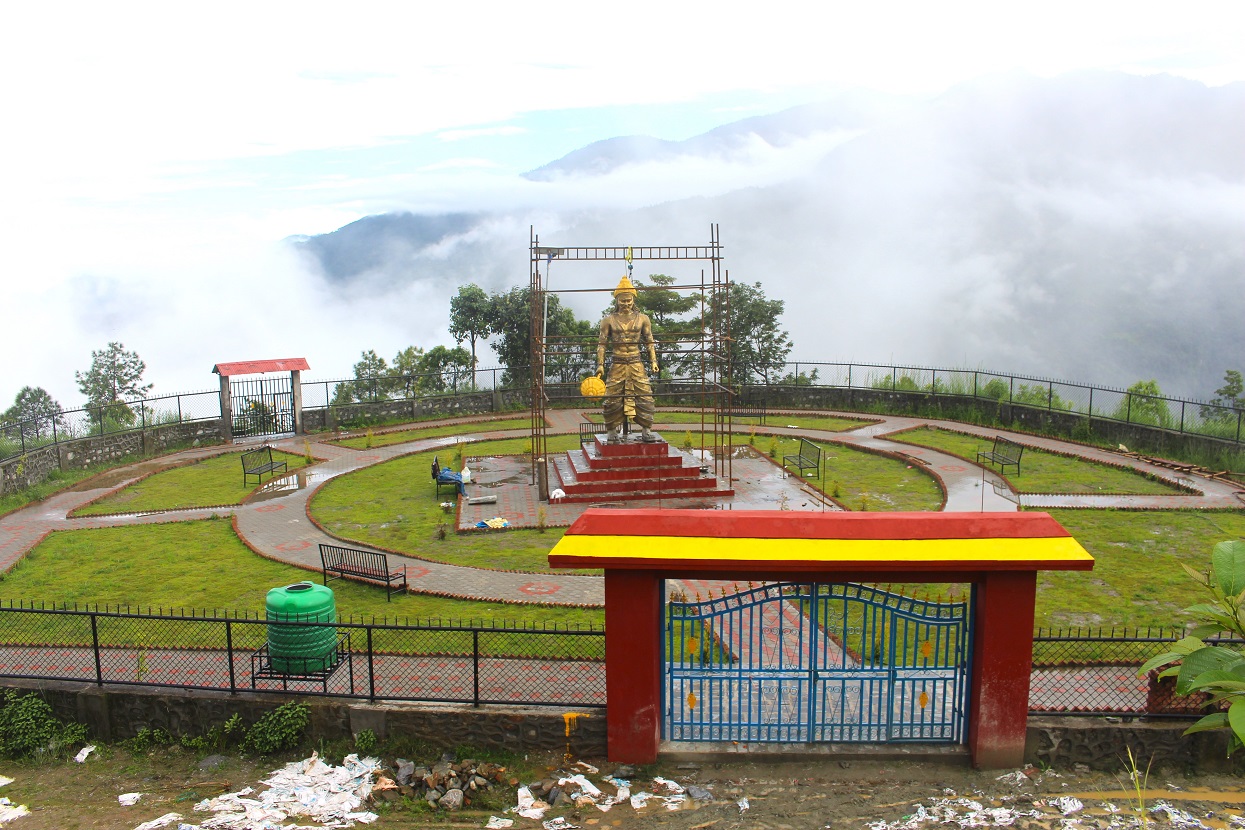
At an altitude of 1,700 meters above sea level, the site has also become home to Nepal’s first “Ravan Park,” built to commemorate local legend that Ravan, the grandson of Sage Pulastya, was born here.
The park, spread over four ropani, features an enclosure, entrance gate, walkways, and landscaped lawns. A 21-foot-tall metal statue of Ravan with ten heads and sacred thread (janai) is under construction.
Other elements such as Ravan’s navel stone and playfield are also being completed.
The project began on Ashwin 17, 2078 BS, and faced delays due to contractor issues and legal disputes before being revived by the municipality.
Mayor Surat KC stated, “The previous administration’s Ravan Park project was left incomplete. We pushed the contractor to continue the work, and now the park is in its final phase with statues and infrastructure being installed.” He added that the park is expected to attract not only Nepali but also South Indian and Sri Lankan religious tourists.
The project’s total cost is Rs 1.76 crore, with 70% funded by the Ministry of Culture, Tourism, and Civil Aviation, and 30% by the municipality.
While the municipality has made its payments, the ministry’s share is pending. Following a court directive, statues of Ram and Sita will also be installed alongside Ravan’s statue after the park’s completion.
Beni–5 Ward Chair Govinda Baniya noted that road upgrades from Beni to Pulachaur and from Chanaute to Pulhashram are underway to facilitate easier access for tourists.
Pulhashram offers panoramic views of the Dhaulagiri, Annapurna, Machhapuchhre, and Nilgiri mountain ranges, along with scenic views of Panchakot, Jyamrukot, Beni Bazaar, the Kali Gandaki River, and surrounding villages.
The site is accessible within a two-hour hike or a 30-minute vehicle ride from Beni, making it an easily reachable and picturesque destination for religious and cultural tourism.