Govt order to vacate holding centers leaves squatters stranded
The government has offered a one-off payment of Rs 25,000 per family, instructing the displaced individuals to manage their own alternative housing.

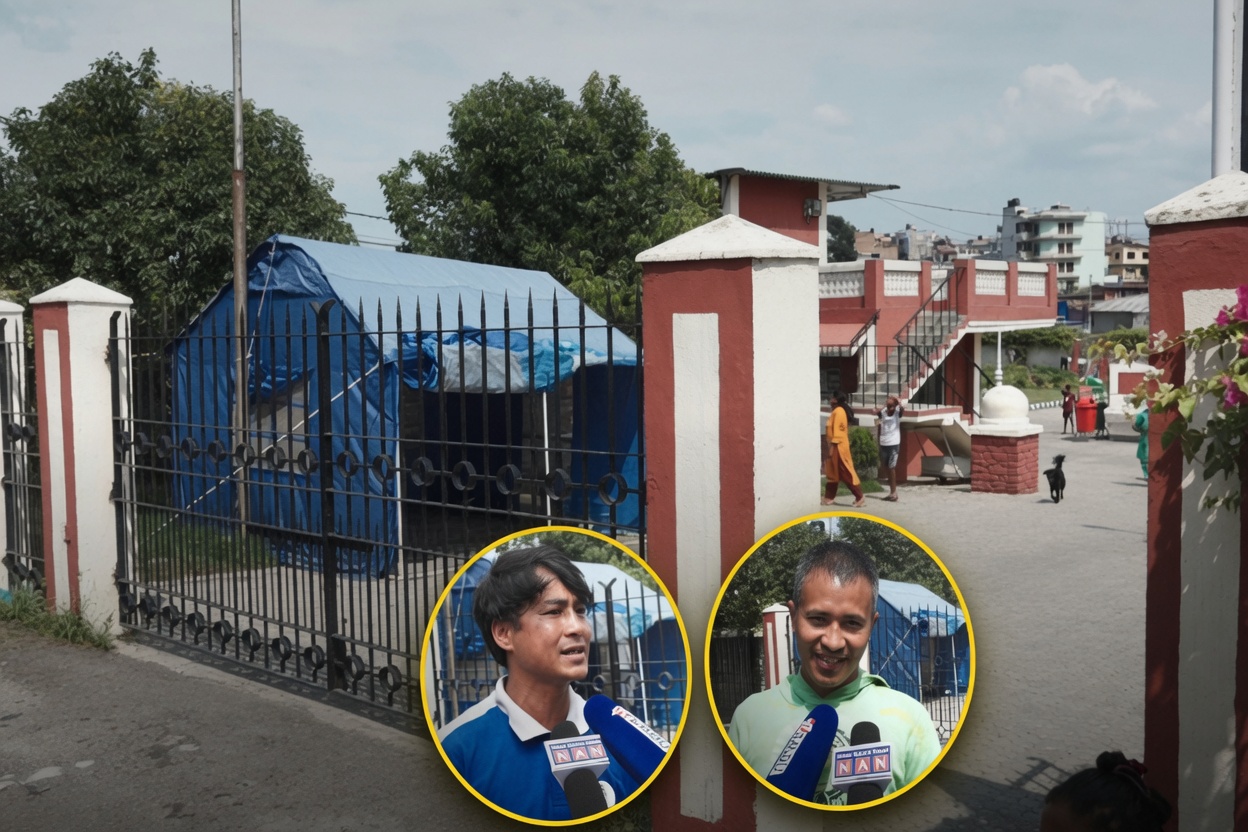
KATHMANDU: Hundreds of landless squatters, previously displaced from the Bagmati Corridor and currently sheltered at a temporary holding centre, have been plunged into deep uncertainty following a sudden government directive ordering them to vacate the premises within five days.
The government has offered a one-off payment of Rs 25,000 per family, instructing the displaced individuals to manage their own alternative housing.
This move has triggered widespread anxiety and anger among the residents, who point out that the authorities had initially promised a permanent resolution to the squatter crisis within three months.
Instead, they are now facing immense pressure to leave with a sum they describe as utterly inadequate.
Racing Against a Friday Deadline
The eviction deadline expires this Friday, yet the vast majority of the displaced families have been unable to secure alternative accommodation.
Dambar Singh Tamang, who has been living at the Radha Soami Satsang Beas holding centre for the past three months, expressed deep distress over the government’s heavy-handed approach. He noted that the sudden mandate to find a rented room and relocate has left his family with nowhere to go.
“I have decided that we will only pack up our belongings and venture out into the streets on the exact day they force us out,” Tamang said, criticising the government’s lack of transparency from the very beginning. “When they initially brought us here, they kept us completely in the dark. They rushed us out of our old settlements, hastily packing our belongings without providing any clear information.”
Tamang further explained that while the authorities instructed them to open bank accounts to receive the Rs 25,000 handout, the money fails to address the root of the problem. “We haven’t received a single shred of state support or sustenance while staying here. For families in our fragile financial position, Rs 25,000 solves absolutely nothing. It is impossible to feed a family, secure housing, and find employment on that amount. The government must cover our rent for at least six months to a year. Alternatively, if they provided eight to nine lakh Rupees, we could build a small shack in Kathmandu or start a small business to sustain ourselves. I desperately need employment to survive.”
Tamang’s household consists of four members, including his wife and two school-aged daughters. He urged the government to prioritise the stability of the children’s education by securing proper housing before disrupting their lives further.
Demands for More Time and Adequate Relief
Another displaced resident, Raju Khatri, echoed these sentiments, stating that the government’s directive is logistically impossible to implement overnight. He argued that families cannot simply vanish at a moment’s notice and require adequate time to transition.
According to Khatri, most families have already filled out the required forms to open bank accounts for the relief fund. However, he stressed that the evacuation should only happen after the funds are cleared, followed by a reasonable grace period.
“Nobody can just leave the moment they command it. Are they going to drag every single person out by force?” Khatri questioned. “Everyone has their own unique hardships and families to look after. They demolished our homes before, and now they are abruptly telling us to leave this shelter. We need at least a month’s time once the money hits our accounts. How can we go out and hunt for rental rooms when we haven’t even been able to work properly? Do we go to work to earn a living, or do we spend our days searching for a room?”
Khatri implored the government not to view the NPR 25,000 sum as a permanent fix. “We aren’t holding out for the greed of money; Rs 25,000 will not change our lives. If things continue like this, it will become a matter of life and death for many,” he warned.
Rising Mental Health Crisis
The looming eviction has also taken a severe toll on the psychological well-being of the displaced community. Khatri highlighted that many residents suffer from pre-existing illnesses, and the sudden threat of homelessness has exacerbated their medical and mental health struggles.
“Up until recently, things were relatively stable here. But ever since the eviction notice was served, everyone has been consumed by overwhelming anxiety. ‘Where do we go? What do we do?’—this is the only question haunting everyone right now,” Khatri added.
The displaced families are collectively demanding that the government honour its original commitment to implement a long-term, sustainable rehabilitation plan. They are calling for guaranteed alternative housing solutions and a sufficient extension of the relocation deadline to prevent a humanitarian crisis on the streets of the capital.