Himalayas, risk, and skies: Nepal’s helicopter industry born of geography
From rescue missions to tourism and cargo, Nepal’s helicopter industry connects remote regions and saves lives in the world’s most challenging terrain.

KATHMANDU: Nepal is a country of unparalleled natural beauty, but this very beauty also presents immense challenges to daily life.
Its mountainous terrain, cliffs, deep valleys, and rugged hills leave thousands of settlements disconnected from road networks.
In some areas, reaching a hospital can take hours or even days.
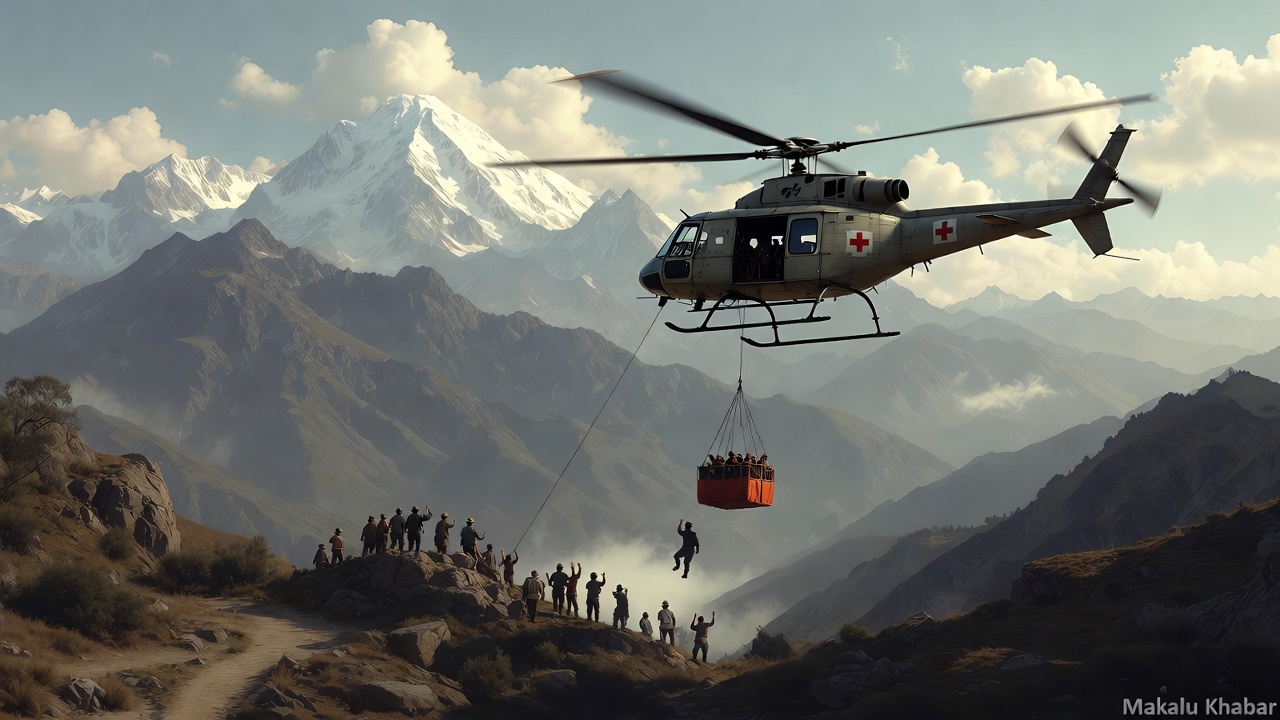
In emergencies or accidents, the sky often becomes the only route for rescue.
This harsh reality has given birth to Nepal’s helicopter industry. Here, helicopter operations are not a luxury—they are a geographic necessity and a critical service.
Helicopter Industry: Service Beyond Commerce
The helicopter industry in Nepal encompasses all commercial operations involving helicopters, focusing primarily on service rather than mere sale or lease of aircraft. Its scope ranges from rescue and tourism to cargo transport, medical evacuations, and government projects.
Extensive Service Applications
In the Himalayas, trekkers often face oxygen deficiency, avalanches, slips and falls, heart attacks, and altitude sickness. In locations like Mount Everest, Annapurna, Lukla, and Kalapathar, helicopters are often the only means to save lives. While insurance companies typically cover foreign tourists’ rescue operations, Nepali citizens frequently bear the cost themselves.
Tourism is another major revenue source for the industry. Services include Everest sightseeing flights, pilgrimages to Muktinath and Gosainkunda, private charter flights, film shootings, photography, and video production.
In remote areas, helicopters transport essential supplies such as food, medicine, and construction materials. They also support infrastructure projects, including hydropower plants, towers, and bridge construction.
Government operations rely heavily on helicopters for the military, police, UN peacekeeping missions, elections, censuses, and disaster management. NGOs and international organizations also frequently deploy helicopters for project work.
RELATED NEWS:
Industry Structure and Revenue
Currently, under the Civil Aviation Authority of Nepal, about a dozen commercial helicopter companies operate, offering charter flights, rescue services, tourism flights, medical evacuations (air ambulances), and cargo transport.
The main revenue source is per-hour flight charges, which typically range from USD 2,000 to 5,000 or higher. Insurance payments for rescue operations are a significant income stream, supplemented by government contracts and tourism packages.
Rescue Costs: Nepal vs. India
Popular rescue helicopters in Nepal include models like the Airbus H-125 (AS-350 B3e), optimized for high-altitude Himalayan operations. A standard rescue mission costs between USD 2,500–4,000 (approximately NPR 330,000–530,000), while extremely remote or high-altitude rescues can exceed NPR 1.2 million.
In comparison, in India, helicopter or air ambulance services usually cost between INR 300,000–800,000 (USD 3,500–9,500). The key differences arise because Nepal’s rescues often occur in high-altitude, remote areas with greater risk and time requirements, whereas Indian services are often urban or in accessible regions. Insurance structures and medical team arrangements also differ.
Airbus H-125 (AS-350 B3e): The Himalayan Workhorse
The Airbus H-125 is a single-engine, lightweight yet powerful multipurpose helicopter. It can operate up to 23,000 feet (7,000 meters), carry up to five passengers including the pilot, and has a maximum takeoff weight of around 2,800 kg. Its maximum speed is approximately 287 km/h, with a cruising speed of around 260 km/h.
This helicopter family holds the world record for the highest-altitude takeoff and landing on Mount Everest, making it ideal for high Himalayan countries like Nepal. Its single-engine design also keeps operational and maintenance costs relatively low. The H-125 is widely used for passenger services, charters, air ambulance operations, search and rescue, and cargo transport.
High-Altitude Realities vs. Paper Specifications
While the H-125 is rated for five passengers, real-world Himalayan operations differ. At altitudes above 5,300 meters, such as Everest Base Camp, thin air reduces engine power and lift capacity. Consequently, evacuating five passengers at once is unsafe.
In practice, rescues usually involve one patient, sometimes accompanied by a medical professional, requiring multiple flights. Passenger capacity varies by location: 3–4 in Lukla or Phakding, 2–3 near Namche, and only 1–2 at Base Camp or Kalapathar.
Overload, Altitude, and Accident Risks
Over the past six decades, Nepal has witnessed more than 40 helicopter accidents and over 90 deaths. Most incidents are linked to harsh weather, thin air, winding terrain, and high altitude. Excess weight at high altitudes reduces lift, making takeoff, maneuvering, and hovering extremely challenging.
Public reports may not always cite overload as a direct cause, but aviation experts and pilots consider the combination of high altitude and weight as a critical risk factor. Recent accidents in Solukhumbu and other Himalayan regions have highlighted how sensitive rescue operations are to weather, terrain, and altitude.
A Business in the Sky, A Responsibility on Earth
While Nepal’s helicopter industry is profitable, its social value is profound. It connects remote communities, showcases Himalayan beauty to tourists, saves patients’ lives, and brings hope during disasters.
Flying over the Himalayas demands uncompromising safety standards: weight management, accurate weather assessment, altitude-specific fuel planning, and strict adherence to regulations.
The small helicopter hovering above the mountains is more than a business—it often represents someone’s last hope, a family’s trust, or a lifeline. In Nepal, the wings of a helicopter carry not just profit, but responsibility, risk, and the weight of humanity.