Pride restored: Nepal end 12-year World Cup drought
Nepal last tasted victory at a Men’s T20 World Cup in 2014, when they defeated Hong Kong and Afghanistan on their debut appearance.

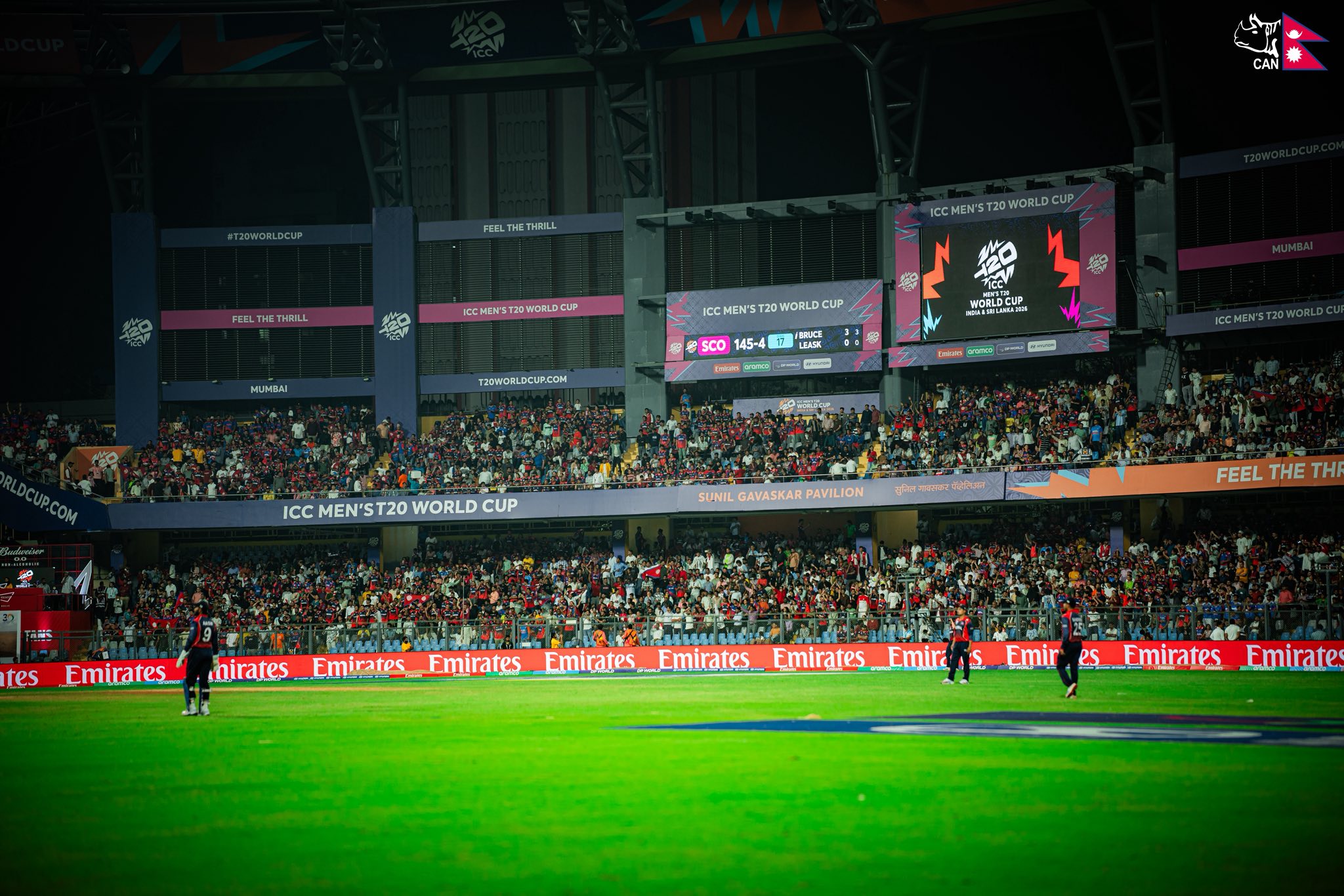
KATHMANDU: After a painful 12-year wait for a World Cup victory, Nepal finally returned to winning ways, defeating Scotland by seven wickets in their final match of the ICC Men’s T20 World Cup in Mumbai. The victory restored pride to the Nepali team and their passionate supporters after a difficult campaign that had ended in early elimination.
Nepal last tasted victory at a Men’s T20 World Cup in 2014, when they defeated Hong Kong and Afghanistan on their debut appearance. Since then, the team had gone winless in World Cup matches for more than a decade. Their triumph against Scotland at the iconic Wankhede Stadium finally brought that drought to an end.
Despite both Nepal and Scotland already being eliminated from the tournament, thousands of Nepali supporters filled the stadium with hope of witnessing a consolation victory. Their faith was rewarded as Nepal produced a disciplined bowling performance followed by explosive batting to secure a morale-boosting win.
Bowling-Led Comeback Sets the Platform
Scotland started confidently, but Nepal turned the match on its head with a sensational bowling spell that saw six wickets fall within five overs. Veteran all-rounder Sompal Kami, playing in his third World Cup, led the attack with three crucial wickets. He was well supported by Nandan Yadav, who claimed two wickets, while captain Rohit Paudel and opener Kushal Bhurtel picked up one wicket each.
The collective bowling effort halted Scotland’s momentum and swung the match firmly in Nepal’s favour.
Dipendra Airee’s Record-Breaking Knock Seals Historic Win
Nepal’s chase was powered by an extraordinary innings from vice-captain Dipendra Singh Airee, who produced a blistering 50 off just 23 balls to win the Man of the Match award—the first of his career at a World Cup. The knock marked his second half-century of the tournament, making him the first Nepali player to score two T20 World Cup fifties in a single edition.
Earlier in the competition against West Indies, Airee had broken Nepal’s long-standing World Cup batting record with 58 off 44 balls, surpassing the previous mark set by Subash Khakurel, who scored 56 runs at the 2014 World Cup. Airee’s performances stand as a landmark achievement in Nepal’s cricketing history.
A Tournament of Painful Lessons
Nepal’s campaign, however, was largely disappointing. They suffered a shock defeat to debutants Italy, after being bowled out for just 123. Italy chased the target without losing a wicket, thanks to an unbroken 124-run opening partnership between brothers Anthony Mosca and Justin Mosca.
Nepal also endured a narrow four-run defeat against two-time world champions England in a match widely praised for Nepal’s fighting spirit. Opener Lokesh Bam impressed with 39 off 20 balls, but half-centuries from Harry Brook and Jacob Bethell proved decisive. Nepal fell short in the final over when Karan KC was unable to find the boundary.
Another heavy defeat followed against West Indies, who went on to qualify for the Super Eight stage.
Fans Turn Wankhede Red Despite Disappointment
Nepali fans created one of the most memorable atmospheres of the tournament. Even on days when India were not playing, the stadium was packed with Nepali supporters dressed in red, chanting, singing, and waving flags. Television commentators praised the remarkable turnout, highlighting the growing global passion for Nepali cricket.
Thousands of supporters had travelled from Nepal and from Nepali communities around the world. While their loyalty was unwavering, repeated defeats left many heartbroken, with some fans expressing anger after investing heavily to follow the team abroad.
Pressure, Planning, and the Social Media Factor
Team officials acknowledged that intense pressure to win affected Nepal’s performance. The narrow loss to England raised expectations, but the team struggled to handle the psychological burden in subsequent matches.
Head coach Stuart Law—a former World Cup-winning player for Australia—also highlighted social media as a growing distraction. He urged players to limit their online engagement during tournaments, warning that constant criticism and external opinions can undermine focus and confidence.
Experts Call for Structural Reform
International commentator Andrew Leonard, who has closely followed Nepali cricket for years, stressed the need for greater batting consistency and smarter bowling strategies focused on building pressure rather than merely hunting wickets. Such expert recommendations underline the urgency for reform within Cricket Association of Nepal.
The Road Ahead for Nepali Cricket
Nepal’s campaign exposed deep-rooted issues in batting stability, death-overs bowling, fielding discipline, tactical flexibility, and mental preparation. Experts have called for structured long-term planning, better investment from the government, and professional support systems including sports psychologists.
Selection policies also require reform. Players should be evaluated based on current form, fitness, and team balance—not past reputation alone. Giving opportunities to young talents could strengthen competition within the squad and improve long-term performance.
While the 2026 World Cup ended in disappointment, the final victory over Scotland has given Nepal a measure of dignity and belief. If lessons from this campaign are taken seriously and reforms are implemented without delay, Nepal can emerge stronger and more competitive on the world stage in the years ahead.