Political realignments ahead of Nepal’s March 5 general election
Clear divisions are emerging, shaping the nation’s electoral battlefield.

KATHMANDU: The political landscape in Nepal is rapidly shifting following the ‘Gen Z’ uprising in Bhadra, with major parties long entrenched in power now recalibrating ahead of the upcoming House of Representatives election on Falgun 21 (March 5).
Clear divisions are emerging, shaping the nation’s electoral battlefield.
On one side, the so-called alternative forces are consolidating.
The Rastriya Swatantra Party (RSP) has absorbed the ‘Ujyalo Nepal Party,’ led by Kathmandu Mayor Balendra Sah and Energy Minister Kulman Ghising, forming a stronger opposition bloc.
On the other side, traditional powerhouses—the Nepali Congress, CPN-UML, and the Maoist-Integrated Socialist Party—are quietly preparing electoral coordination within the broader framework of the Nepali Communist Party (NCP).
The rising strength of alternative parties has put direct pressure on established players.
For Congress and UML, particularly weakened by the Gen Z movement, this election represents a battle for political survival.
Recognizing the difficulty of facing these new forces alone, top leaders of the three major parties are actively laying the groundwork for an ‘undeclared grand alliance.’
Internal dynamics are complex. Within Congress, friction between party president Sher Bahadur Deuba and the dual general secretaries (Gagan Thapa and Bishwprakash Sharma) has slightly complicated coordination with UML.
Yet, dialogue remains ongoing at the top level.
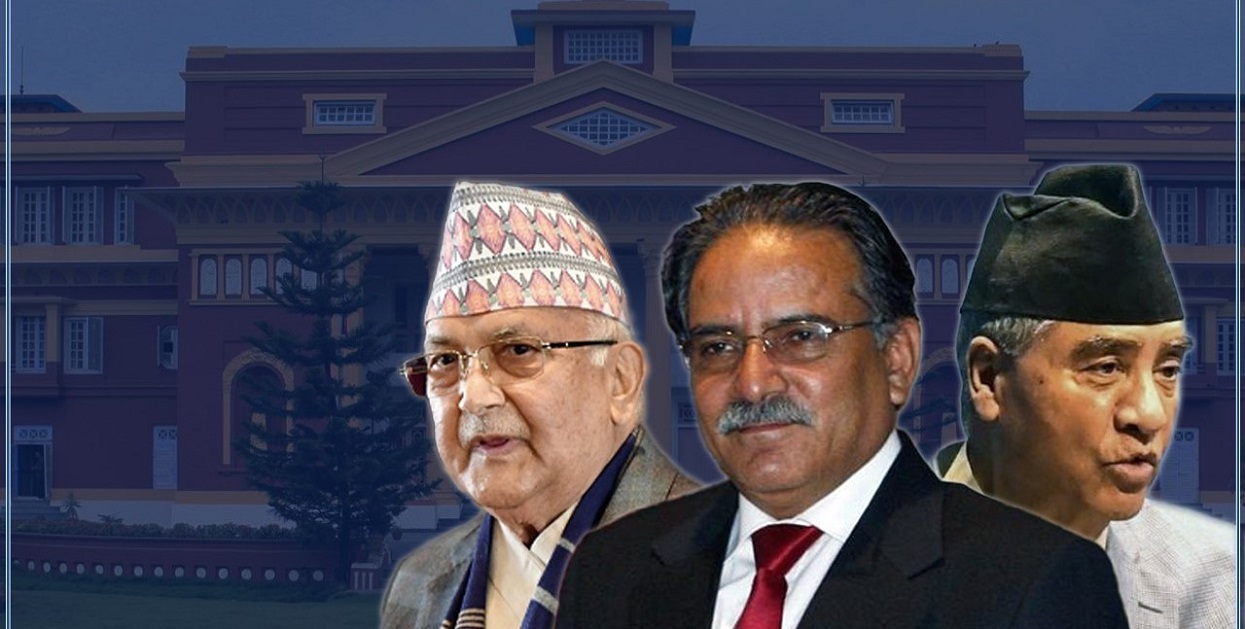
CPN-UML Chair KP Sharma Oli has conducted separate one-on-one talks with Congress President Deuba and NCP Chair Pushpa Kamal Dahal ‘Prachanda,’ fostering an environment for collaboration amid continuous consultations.
Before the general election, the National Assembly election on Magh 11 is expected to serve as a critical litmus test for the old parties. With 18 vacant seats, the three-party coordination virtually ensures victories across all seven provinces.
In preparation for the nomination deadline on Poush 23, second-tier leaders—including Congress’s Purna Bahadur Khadka and Ramesh Lekhak, UML’s Shankar Pokhrel, and NCP’s Barsaman Pun—are actively negotiating joint candidates.
Dissent Over Interim Government
In a confidential meeting held Sunday at a private residence in Chyasal, Lalitpur, UML Chair Oli and NCP Chair Prachanda expressed dissatisfaction with the interim government.
They concluded that Prime Minister Sushila Karki’s administration had failed to create a neutral election environment, citing ministers openly campaigning against older parties.
According to Prachanda’s personal secretary Govinda Acharya, the leaders also reviewed security lapses, including the reduction of their protective details despite rising threats, and expressed concern over perceived government bias.
The Gen Z movement has, in effect, brought Oli and Prachanda—once divided since the 2077 NCP split—back into the same negotiation space.
Political activities are intensifying. On Sunday evening, Prachanda departed for New Delhi.
While the Secretariat framed the trip as a pre-scheduled engagement with diaspora organizations, political circles view it with keen interest, as it marks his first visit to India since the prospective three-party alliance emerged.