Oli re-elected UML Chair: A journey marked by struggle, prison & political resilience
Oli is also regarded as a leader who does not hesitate to provide protection and support to his political base.

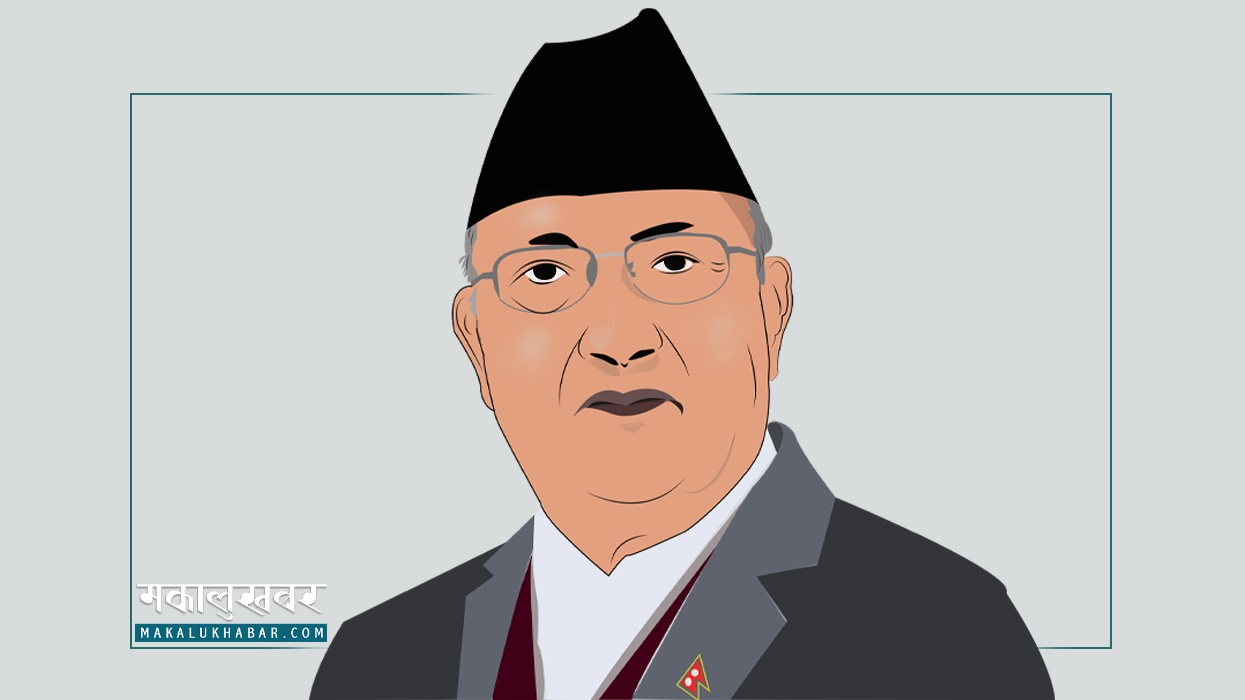
KATHMANDU: Newly elected Chairperson of the CPN-UML, KP Sharma Oli, is widely recognized in Nepal’s political landscape as a resilient, battle-hardened leader who has endured prolonged struggle, imprisonment, and political upheaval. Known for being studious, firm in decision-making, and unwaveringly loyal to leaders, cadres, and supporters who trust him, Oli is also regarded as a leader who does not hesitate to provide protection and support to his political base.
Having already led the UML for two terms, Oli was re-elected for a third term as party chairperson at the 11th National Convention held in Kathmandu, securing 1,099 more votes than his closest rival, Ishwar Pokharel. A central figure since the days of the Jhapa rebellion, Oli has navigated numerous political highs and lows—including long years of imprisonment—to remain at the core of Nepal’s political power structure. He has led the country three times as Prime Minister.
Most recently, Oli assumed office as Prime Minister for the fourth time on Asar 31, 2081 BS, through cooperation with the Nepali Congress. However, following the Gen Z movement on Bhadau 23 and 24, he resigned from the post.
Although voices advocating generational transition and leadership handover were raised within the party during the 11th National Convention, which began in Kathmandu on Mangsir 27, delegates selected from across the country and provinces once again entrusted Oli with the party’s leadership. As the UML remains the second-largest party in the dissolved House of Representatives, Oli now faces the challenge of steering the party amid evolving political developments following the Gen Z movement.
Oli was first elected UML chairperson on Shrawan 1, 2071 BS, at the party’s 9th National Convention in Kathmandu, and was re-elected at the 10th National Convention held in Chitwan in the second week of Mangsir 2078 BS. Known for his clear stance on prosperity, development, and nationalism, Oli carries the image of a confident yet determined—often described as stubborn—leader.
Following the promulgation of Nepal’s current Constitution, Oli became Prime Minister for the first time on Ashoj 24, 2072 BS. He assumed office for the second time on Falgun 3, 2074 BS, with nearly a two-thirds majority, backed by the then CPN (Maoist Centre).
After the unification of the UML and the Maoist Centre on Jestha 3, 2075 BS, Oli became the senior chairperson of the unified party. However, internal disputes and party division led to a controversial decision to dissolve Parliament, which was later overturned by the Supreme Court, forcing him out of government.
Born into a lower-middle-class family to father Mohan Prasad Oli and mother Madhumaya, former Prime Minister Oli has endured long struggles, repeated imprisonment, and severe torture in the fight for democracy. He was born on Falgun 11, 2008 BS, in Iwa village of Atharai, Terhathum, to a modest farming family. He lost his mother at the age of four and was raised by his grandmother, Ramadevi Oli.
Oli often recalls that alongside his studies, he performed all the tasks typical of a rural farming household during his childhood. In 2020 BS, his family migrated from Terhathum to Jhapa, where he became deeply immersed in the district’s social, cultural, educational, and economic environment. As a curious adolescent, he began questioning social inequality, discrimination, and injustice.
Oli’s political rise emerged from the Jhapa Movement and a period of intense underground struggle. He played a leading role in movements opposing the monarchical Panchayat system, consistently advocating for nationalism, democracy, equality, social justice, non-discrimination, and public awareness.
Throughout his political career, Oli has emphasized the strengthening of democratic institutions, protection of national sovereignty, commitment to democratic values, and safeguarding society from extremism and provocation. Carrying the national aspiration of “Prosperous Nepal, Happy Nepali,” he has remained relentlessly active in public service—both in and out of government. He is also recognized as a skilled orator, logical thinker, and studious leader.
At the age of 15, in 2023 BS, Oli joined a Marxist study group led by Ramnath Dahal. Dahal and four other activists were later killed by the Panchayat government in the Sukani forest under the pretext of being transferred to jail.
Two years after joining the study group, Oli became a full-time political activist and obtained membership of the Communist Party of Nepal in Magh 2026 BS. That same year, he was arrested for the first time by the Panchayat government.
During protests against the Panchayat system, Oli and other Jhapa Movement revolutionaries were arrested again in 2030 BS. He spent 14 years in harsh imprisonment, including four years of torture in solitary confinement (Golghar).
While in prison, Oli became a founding member of the Communist Party of Nepal (Male) formed on Poush 11, 2035 BS. After his release on Asar 11, 2044 BS, he was appointed a central committee member at the party’s meeting held on Poush 2, 2044 BS, and later served as Lumbini Zone In-charge for the anti-Panchayat movement.
Following the success of the people’s movement led by the CPN (Male) that ended the Panchayat system, Oli became the founding president of the Democratic National Youth Federation of Nepal on Jestha 1, 2047 BS.
As part of efforts to unify and expand the communist movement, the CPN (Male) and CPN (Marxist) merged on Poush 22, 2047 BS, forming the CPN (UML), where Oli continued as a central committee member.
After the restoration of multiparty democracy, Oli was elected to the House of Representatives from Jhapa Constituency No. 6 in 2048 BS, and again from Jhapa Constituency No. 2 in the 2051 BS mid-term election. Over the years, he held key party responsibilities, including Politburo member, head of the Foreign Department, Publicity Department, and Parliamentary Department, and later served as Deputy Prime Minister and Foreign Minister.
Following the restoration of multiparty democracy, Oli became Home Minister for the first time in 2051 BS, in Nepal’s first democratically elected communist government led by Manmohan Adhikari.