Nepal’s first Rhino Cruise sets sail on Narayani River
The cruise was inaugurated on Sunday evening and has started regular service.

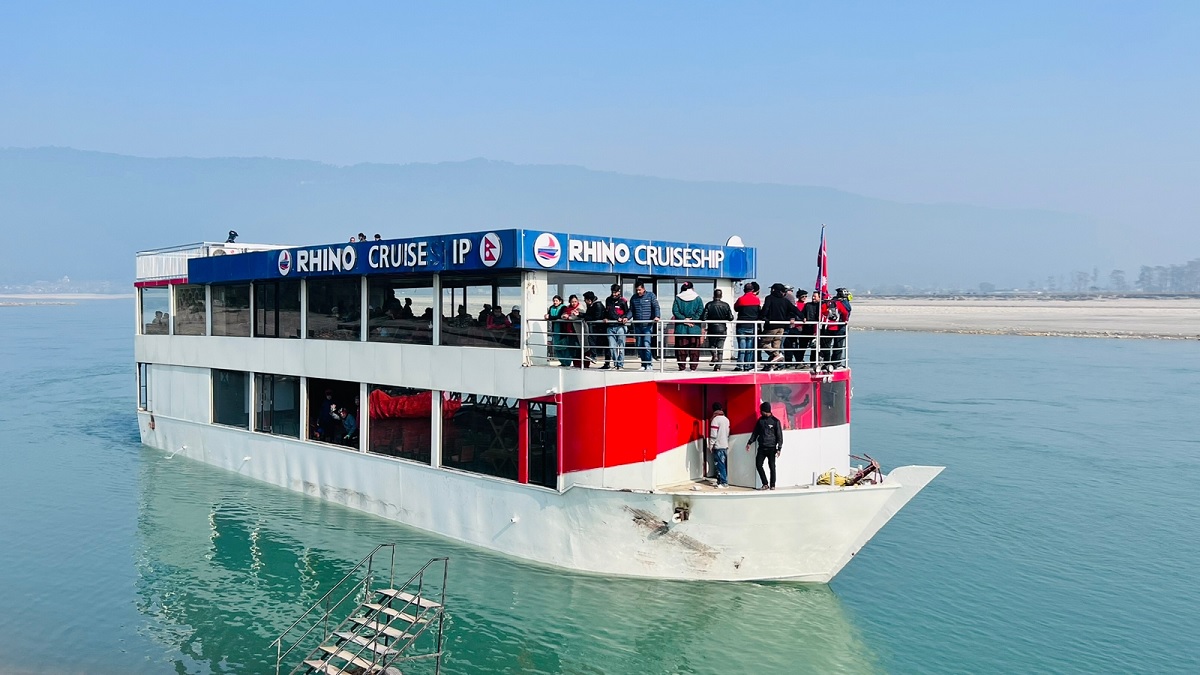
KATHMANDU: Nepal’s first-ever cruise, the Rhino Cruise, has officially begun operations on the Narayani River in Gaindakot, Nawalparasi (Bardaghat–Susta East), aiming to boost river tourism and connect the region’s religious and cultural destinations.
The cruise was inaugurated on Sunday evening and has started regular service.
The Rhino Cruise is part of a broader initiative to create a sustainable and high-potential tourist destination in Nawalpur and surrounding areas.
Speaking at the inauguration, Mayor of Gandakot Municipality, Madanbhakta Adhikari, called the cruise a “jewel of Gaindakot” and pledged municipal support for its operations.
He said the importance of extending the cruise route beyond Devghat Dham to Triveni Dham, highlighting the need to remove river obstacles and deepen the Narayani to facilitate smooth navigation.
Dr. Tilchandra Bhattarai, former central member of the Federation of Nepalese Chambers of Commerce and Industry (FNCCI) and chairman of Hotel River Crown, noted that the cruise is integrated with local hotel networks to enhance tourism activities.
He stressed that the Rhino Cruise would contribute not only to Gandakot and Nawalpur’s development but also to the broader economic growth of the region.
Hotel entrepreneur Prabhakar Pandit highlighted that the cruise introduces a new dimension to national tourism, benefiting Nawalpur, Chitwan, and surrounding areas.
He added that the cruise would stimulate local economic activity and promote domestic tourism.
Deepak Dhungel, Managing Director of Rhino Water Entertainment Pvt. Ltd. and Hotel River Crown Pvt. Ltd., said the cruise has permission to navigate 40 kilometers along the Narayani River, southward from Devghat.
The two-and-a-half-story cruise measures 95 feet in length and 21 feet in width, with a full capacity of 200 passengers, although it will operate with 150 passengers for comfort and service quality.
Dhungel emphasized that the cruise is designed purely for leisure and recreational purposes, not transportation, with typical trips lasting one hour, adjustable depending on special packages or events.
The cruise will host a variety of programs, including breakfast, lunch, and dinner cruises, weddings, religious ceremonies, naming ceremonies, birthdays, and other special events.
Ticket prices are set at Rs 500 for standard trips, Rs 1,500 for breakfast cruises, Rs 2,000 for lunch cruises, and Rs 3,000 for dinner cruises, with customized pricing for special events. Each passenger is insured for up to Rs 1 million.
Dhungel highlighted that the project, with an initial investment of Rs 500 million, aims to establish Gandakot and the Narayani River as South Asia’s premier river tourism destination, integrating religious sites, natural beauty, and luxury hospitality into a sustainable economic cycle.
The cruise is designed to operate year-round, even in strong winds and river currents, linking key destinations such as Devghat Dham, Maulakalika, Valmiki Ashram, Chitwan’s Sauraha, and Lumbini into a unified tourism corridor.
The Rhino Cruise is expected to attract both domestic and international tourists, combining river travel, religious tourism, and luxury hospitality.
Key municipal and business representatives, including Deputy Mayor Shanti Koirala, Chhavi Kandel of District Industry and Commerce Association Gandakot Nawalparasi, and Shiv Paudel of the Hotel Entrepreneurs Association Mukundpur Maulakalika Area, highlighted the cruise’s potential to transform the district into a major tourist hub.
Cruise board member Badriprasad Adhikari added that the project would boost local production and generate employment, currently providing direct jobs to 50 people through cruise and hotel operations.