Kisunji’s 102nd birth anniversary at vandalised ashram
No special programmes were organised, and no leaders or political figures were seen paying tribute.

KATHMANDU: Unlike previous years, there was no bustle on Tuesday at the ashram of former Prime Minister Krishna Prasad Bhattarai, widely known as Kisunji, in Bandegaun, Lalitpur.
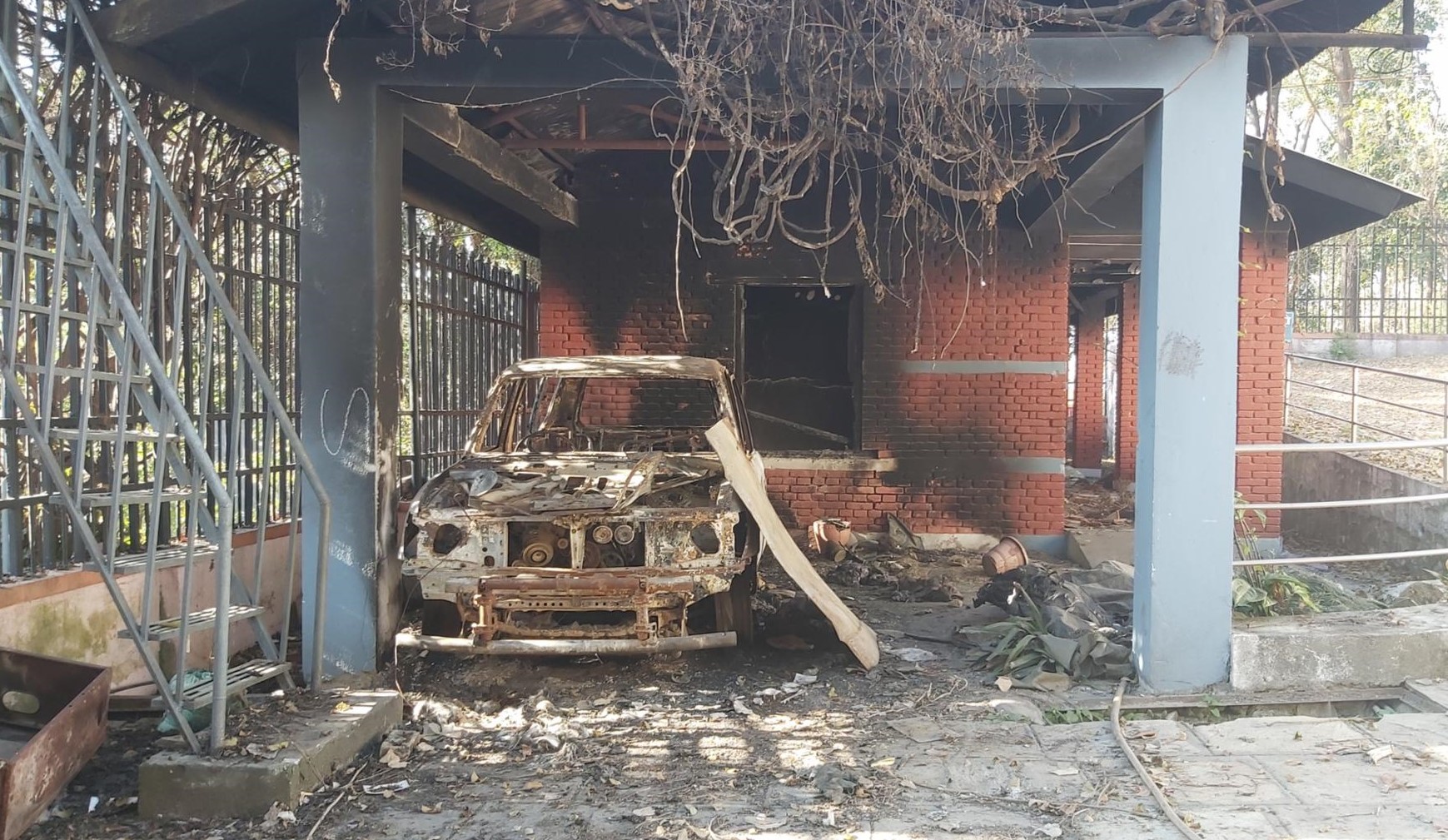
Once a place of remembrance and political reflection, the ashram has remained deserted since it was vandalised during the Gen Z movement on Bhadra 23 and 24, when arson and vandalism reduced the historic site to ruins.
As a result, the ashram remained closed on Poush 8, which marks both Bhattarai’s birth anniversary and memorial day.
No special programmes were organised, and no leaders or political figures were seen paying tribute.
Barbed wire wrapped around the locked gate, two burnt vehicles abandoned inside the compound, shattered windowpanes, and a dismantled event structure bore testimony to the destruction.
The statue of Kisunji standing in front of the ashram had also been vandalised.
For many, the sight of the damaged memorial of a leader who chose principles over power and spent years in prison for democracy was deeply moving.
Born on Poush Krishna Dwadashi, 1981 B.S. in Banaras, India, Krishna Prasad Bhattarai’s life mirrors Nepal’s modern political history, says former lawmaker and political scholar Professor Hom Raj Dahal.
“Due to the hostility of Rana Prime Minister Bir Shumsher, Bhattarai’s family was forced into exile in Banaras. That environment pushed him towards politics. He was actively involved in the 1942 ‘Quit India Movement’ and was jailed for the first time then. From his student days, he emerged as a carrier of political consciousness,” Dahal said.
While studying at Banaras Hindu University, Bhattarai became vice-president of the Nepal Students’ Union and played a key role in spreading political awareness among Nepali youths.
In 2003 B.S., when the All India Nepali National Congress was formed, he became its General Secretary.
Later, after the unification of the Nepali National Congress and Nepal Praja Democratic Congress, he served as Joint General Secretary of the Nepali Congress.
His role as commander of the liberation army that captured Janakpur–Udayapur during the 2007 B.S. armed revolution is firmly recorded in history.
Following King Mahendra’s coup on Poush 1, 2017 B.S., Bhattarai was arrested from Thapathali along with B.P. Koirala and spent a continuous 10 years in prison. Altogether, he spent more than 14 years behind bars, yet never chose exile.
Professor Dahal recalls preparing a research paper on Bhattarai’s political biography during his postgraduate studies in 2050 B.S., noting that Bhattarai firmly believed democracy could be achieved through non-violent struggle.
Soon after his release from prison, Bhattarai inaugurated the founding ceremony of the Nepal Students’ Union on Baisakh 6, 2027 B.S., energising the student movement.
After the Patna Conference of 2034 B.S., B.P. Koirala entrusted him with the responsibility of Acting President of the Nepali Congress due to health reasons.
Former minister and Nepali Congress leader Omkar Prasad Shrestha said Bhattarai continued as Acting President for nearly one and a half decades even after Koirala’s death.
“Kisunji chaired the People’s Movement, served as Interim Prime Minister in 2047 B.S., presided over the declaration assembly of the 2046 B.S. People’s Movement, and led the Kshetrapati Conference. After the success of the movement, he fulfilled the responsibility of drafting the constitution and holding elections within a year, proving that duty mattered more to him than power,” Shrestha said.
Ironically, Bhattarai lost the 2048 B.S. election held under his own premiership. He was also defeated in Gorkha in 2015 B.S. and from Kathmandu Constituency No. 1 in 2051 B.S. Yet electoral defeat never diminished his stature; instead, it reinforced his image as a saintly leader.
Bhattarai remained unmarried throughout his life. His simple lifestyle is considered rare in Nepali politics. When he resigned as Prime Minister, he left Baluwatar carrying only an umbrella and a water pot (kamandalu).
Many still recall the image of him walking out of Baluwatar on foot after losing the 2048 B.S. election, umbrella in hand, as a lasting symbol of political morality.
Krishna Prasad Bhattarai passed away at 11:26 pm on Falgun 20, 2067 B.S. at Norvic International Hospital in Kathmandu. He was cremated with state honours at Pashupati Aryaghat on Falgun 21.