Best ISPs in Nepal 2026 (latest price & offers)

KATHMANDU: Choosing the best Internet Service Provider (ISP) in Nepal in 2026 is no longer just about speed or price.
With work‐from‐home, professional esports gaming, online education, 4K streaming, cloud gaming, content creators and smart homes becoming the norm, users now demand consistent performance, modern Wi‐Fi technology, transparent pricing, and reliable after‐sales support.
This article follows a neutral, comparison‐based format similar to leading tech portals, while going deeper into real‐world experience, router technology, and total cost of ownership areas often ignored in generic ISP lists.
The goal is simple: help users choose the right ISP for their actual usage, not just advertised numbers.
Current ISP Market Scenario in Nepal (Based on NTA MIS – Poush 2082)
Nepal’s fixed broadband market has entered a high‐growth but highly competitive phase.
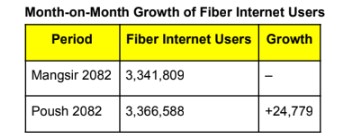
According to the latest Management Information System (MIS) report published by the Nepal Telecommunications Authority (NTA) for Poush 2082, the total number of fiber broadband internet users in Nepal has surpassed 33.66 lakhs (3,366,588 users).
This marks a monthly growth of 24,779 new fiber users compared to Mangsir 2082, clearly indicating sustained demand for fixed broadband connectivity.
With this growth, fixed wired broadband penetration has reached approximately 50.45% of Nepal’s population, a significant milestone for a country with challenging geography and historically limited digital infrastructure.
Fiber‐to‐the‐home (FTTH) has now become the dominant mode of fixed internet access, replacing legacy ADSL and wireless connections across urban and semi‐urban regions.
This steady growth reflects three major trends in the Nepali market:
- Rising work‐from‐home and hybrid work culture
- Increased OTT streaming, gaming, and content creation
- Rapid adoption of smart TVs, IoT devices, and multi‐device households
Customer Base of Major ISPs in Nepal updated 2026
While dozens of ISPs operate under NTA licenses, the fiber broadband market is heavily consolidated, with a few large private ISPs controlling the majority of subscribers.
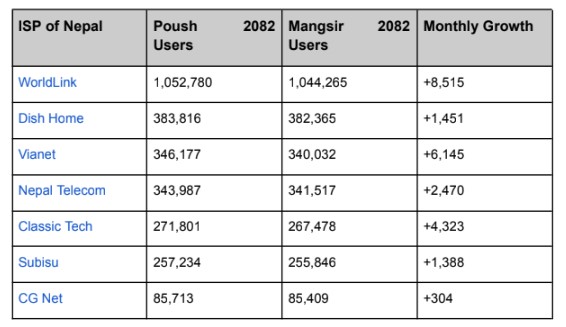
Fiber Internet Subscribers by ISP (NTA – Poush 2082)
How We Ranked the Best ISPs in Nepal (2026 Criteria)
To ensure a fair and practical comparison, ISPs are evaluated on the following parameters:
1. Internet Speed & Stability – Real‐world performance during peak hours
2. Router & Wi‐Fi Technology – WiFi 5 vs WiFi 6 readiness
3. Pricing & Value for Money – What you pay vs what you actually get
4. Customer Support & Service Quality – Responsiveness and transparency
5. Future‐Readiness – Ability to support multi‐device and next‐gen usage
List of Best Internet Service Providers in Nepal 2026
1. Classic Tech
Classic Tech has 271,801 fibre internet users, adding around 4,323 subscribers in Poush 2082, a growth rate of roughly 1.6%. Although its absolute subscriber count is smaller than the largest ISPs, its growth efficiency and technological positioning are strong indicators of competitive momentum.This forward-looking strategy positions Classic Tech as a provider that emphasizes real-world user experience, not just raw speed or market share.
Classic Tech stands out as best internet service provider in Nepal not by aggressive marketing, but by solving a core problem faced by most Nepali internet users: the gap between fiber speed and actual Wi‐Fi experience inside the home.
Unlike other ISPs, Classic Tech includes a WiFi 6 router as standard on all plans since 2021, starting from 50 Mbps. This makes a significant difference in homes with multiple connected devices. Classic Tech has also become only isp to provide Wifi 6 Router in 50Mbps Plan at a nominal cost . New user acquisition
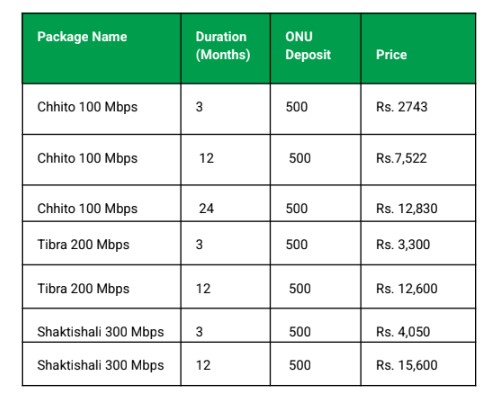
Classic Tech Internet Packages (2026)
Strengths
● WiFi 6 router included on all plans only at Rs 1130 Rental charge
● Stable performance during peak hours
● Transparent pricing and clear FUP
● Network coverage in the 74 districts of Nepal
● Strong customer support via call, app, and WhatsApp
Limitations
● Coverage is still expanding in some rural areas, mainly the Himalayan region
2. WorldLink Communications
WorldLink continues to dominate Nepal’s fiber internet landscape with over 10.52 lakh subscribers, making it the largest ISP in the country by customer base.
However, when examined closely, its month-on-month growth rate stands at approximately 0.8%, with a net addition of 8,515 users, which is relatively modest considering its scale.
Pricing also remains a concern for many users, as WorldLink’s plans are often perceived as more expensive compared to competing ISPs offering similar or better in-home performance.
Additionally, while several ISPs such as Classic Tech, which introduced WiFi 6 routers as early as 2021 have already adopted modern Wi-Fi standards, WorldLink only recently launched its WiFi 6 offering calling it 6G.
This delayed adoption highlights a gap between network scale and in-home technology readiness, which increasingly influences customer satisfaction in multi-device households.
WorldLink publishes residential broadband pricing online on its official site.
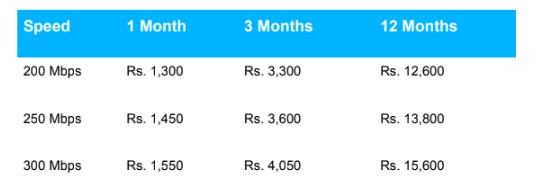
Router deposit and optional mesh (Beacon) deposits apply separately. NetTV packs add extra costs.
3. Vianet Communications
Vianet has climbed to the third position among fiber ISPs with over 3.46 lakh users, driven by a strong growth rate of approximately 1.8% month-on-month (adding 6,145 users). This growth rate is among the highest in the market relative to base size, indicating strong adoption momentum.
However, many Vianet plans still ship with older Wi-Fi 5 routers, meaning that users who want the latest in-home technology they need to spend additional money on that. It only providing wifi 6 router on high end package only.
Vianet’s official site lists annual package pricing.
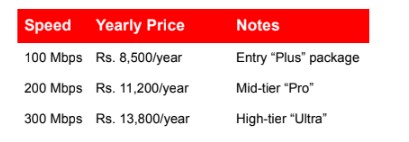
Extra installation and router/ONU charges may apply beyond yearly subscription.
4. DishHome FiberNet
Dish Home FiberNet holds the second-largest fiber subscriber base with over 3.83 lakh users, largely driven by its ability to cross-sell internet services to its existing television customer base. However, its monthly growth rate of around 0.38% suggests relatively slow organic expansion compared to other private ISPs.
While Dish Home offers attractive TV + internet bundle packages, its standalone broadband service lags in terms of router technology and network optimization. Most plans still rely on basic Wi-Fi equipment, which can affect real-world performance during peak hours, especially for users who prioritize internet usage over television services.
DishHome pricing details are captured from industry trackers.
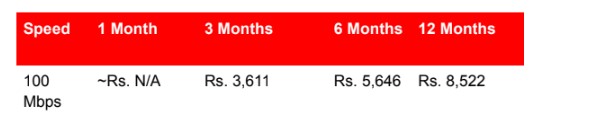
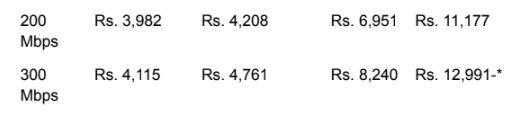
DishHome also offers combo packages (Internet + TV) at additional costs.
5. Nepal Telecom FTTH
Nepal Telecom, the country’s oldest telecom operator, has gradually expanded its NT Fiber FTTH service to reach over 3.43 lakh users, registering a monthly growth rate of approximately 0.7%. Backed by extensive national infrastructure, NT Fiber plays a critical role in bringing broadband connectivity to areas where private ISPs have limited reach.
Despite this, Nepal Telecom continues to face challenges related to service agility and customer experience consistency. While pricing remains competitive, the lack of standardized modern Wi-Fi equipment and slower innovation cycles mean that users often do not experience the full potential of fiber connectivity without additional hardware investments.
Latest detailed pricing from Nepal Telecom’s FTTH data.

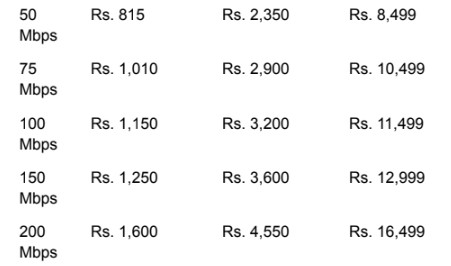
Installation & telco benefits vary by package (NTTV & voice bundles).
6. Subisu CableNet
Subisu remains one of Nepal’s long-established ISPs, with a fiber subscriber base of 257,234 users as of Poush 2082. The ISP added 1,388 new users month-on-month, translating to a growth rate of approximately 0.54%, which is relatively slow in a market where several competitors are expanding at over 1% monthly.
This modest growth reflects Subisu’s legacy-heavy positioning and slower pace of modernization. While the company has transitioned from cable to fiber, it continues to rely largely on older Wi-Fi standards and conventional service models, offering limited differentiation for modern, multi-device households.
As user expectations increasingly shift toward seamless in-home Wi-Fi performance, Subisu faces mounting pressure to refresh both its technology stack and customer experience.
Subisu’s site lists offerings but not direct prices on the public page available. General market guides suggest fiber plans typically align with rates similar to older ranges: ~Rs. 11,500–Rs. 18,000 per year for 200–300 Mbps, often bundled with Clear TV.
Exact public pricing isn’t easily found without contacting local sales.
7. Websurfer Nepal
Websurfer’s official site does not publicly list detailed plan prices, but offers indicate low starting prices (~Rs. 950–Rs. 1,034/month) for basic fiber plans and bundle packages.
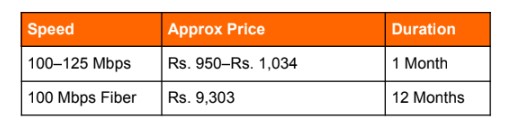
Exact per-speed pricing must be confirmed locally (site not published mobile version).
8. Techminds Network
Techminds does not list pricing publicly; available industry guides only approximate mid-tier pricing comparable to smaller ISPs (~Rs. 1,000–1,300/month) depending on speed and contract term.
9. WiFi Nepal
WiFi Nepal is positioned as a budget-focused ISP, targeting price-sensitive users such as students and small households. While its lower pricing helps attract entry-level subscribers, the ISP faces challenges related to scalability, coverage consistency, and service reliability. Growth remains incremental, and the lack of advanced Wi-Fi technology and network optimization limits its appeal for users with higher performance expectations.
10. CG Net (CG Communications)
CG Net currently serves 85,713 fiber internet users, recording a net addition of just 304 users in Poush 2082, resulting in a month-on-month growth rate of approximately 0.35% one of the lowest among major ISPs. Despite being a relatively new entrant, its recent growth suggests slower adoption momentum compared to both established players and fast-growing challengers.
Although CG Net gained early visibility by triggering Nepal’s internet speed competition in 2021, its current expansion appears constrained by limited coverage, refundable deposit requirements, and basic in-home Wi-Fi equipment.
As the market matures, CG Net’s future growth will depend less on headline speed claims and more on improving service reliability, coverage depth, and overall customer experience.
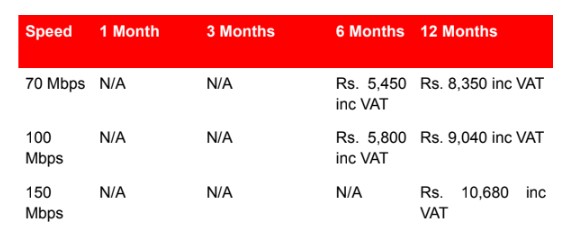
CGNet’s official site shows multiple residential packages.
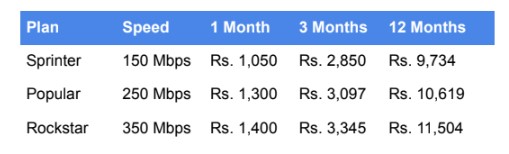
IPTV “Jodi” bundles cost extra on top of base internet pricing.
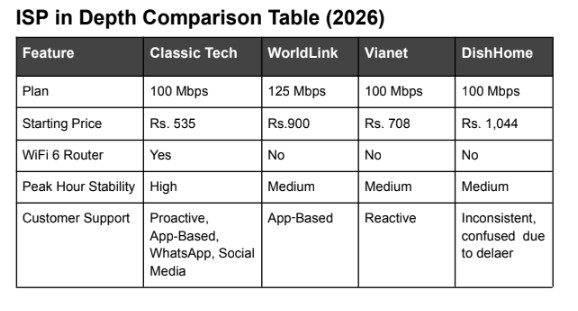

Final Verdict: Which ISP Should You Choose in 2026?
All major ISPs in Nepal offer fiber internet, but the overall experience differs significantly once router quality, peak‐hour performance, and hidden upgrade costs are considered.
For users who want true value, modern Wi‐Fi performance, and minimal hassle, Classic Tech emerges as the best overall ISP in Nepal for 2026.
While WorldLink and Vianet remain strong alternatives based on coverage and latency, Classic Tech decision to make WiFi 6 standard across all plans even in BTL 50 Mbps Package gives it a clear edge in real‐world usage.