Tap water reaches Dewaratoli, ending generations of struggle
Only a few years ago, a suspension bridge was built across the river, allowing villagers to walk 20 minutes westwards along a narrow flat trail before facing a terrifying cliff.

KATHMANDU: In the northern edge of Dewaratoli village in Kalikot, the Kanchan Tilaganga River flows steadily below, but just two kilometers above, the settlement’s steep slopes and barren ridges have long defined hardship for residents.
Only a few years ago, a suspension bridge was built across the river, allowing villagers to walk 20 minutes westwards along a narrow flat trail before facing a terrifying cliff.
Looking down its vertical drop is enough to make anyone shudder. It was here, three years ago, that 42-year-old Chandrabahadur Bishwokarma of Dewaratoli nearly lost his life.
Carrying a sack of rice uphill, he slipped and became stuck on the cliff. “I was returning home in the evening with a sack of rice.
Halfway across the cliff, I slipped,” he recalled. “I almost fell into the Tilaganga River. Luckily, I got stuck on the ledge. Villagers rescued me the next day. I had head injuries, and treatment in Nepalgunj cost me seven lakh rupees.”
The climb from the cliff’s base to the village takes at least 45 minutes of steep ascent. Over the years, countless livestock and water pots have tumbled into the river.
The cliff has since been named ‘Chandre Cliff’ by villagers, after Chandrabahadur’s near-fatal fall.
Residents of Tilagufa-1 Dhattakki, located across the river in the dry hill region, still walk through the same cliff to collect grass and firewood.
After the cliff ends, a pine forest stretches across a small flat patch, followed by another uphill trail that leads to Dewaratoli. Along this route lies a small natural spring where a tank was built to collect water.
For decades, women walked hours daily to fetch water from the tank at the edge of the village.
During winter, when the spring dried up, they were forced to descend all the way to the Tilaganga River.
Sixty-eight-year-old Sani BK vividly remembers the suffering. “I spent my youth carrying water. I lost count of how many pots fell off the cliff,” she said. “There was no time to rest or look after babies. We couldn’t even drink water to quench thirst properly. We took livestock to the river for water. Growing vegetables was impossible.”
A Historic Change Arrives
In recent weeks, life in Dewaratoli has transformed. Women no longer walk long distances with water pots.
Children are reaching school on time. Front yards are filled with freshly planted vegetables, nourished by the water flowing directly into homes.
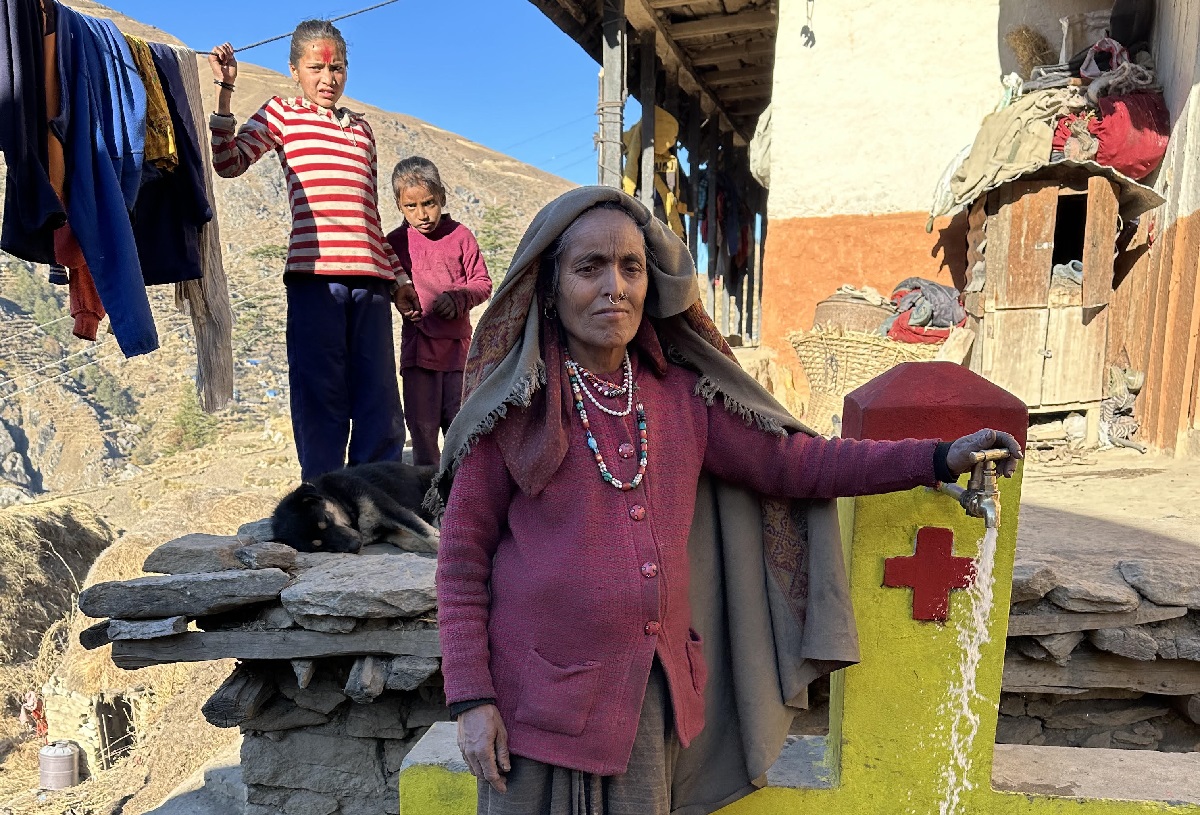
Taps have now been installed in the courtyards of every household. The Dalit-majority settlement of around 45 households and nearly 300 people has seen joy return after decades of struggle.
“The day water started flowing from the tap in my yard, I could not sleep out of happiness,” Sani BK said. “I just wanted to keep looking at the tap. Our worries have finally ended. Now we can grow vegetables, feed livestock, and maybe even plant potatoes.”
Poor crop yields had long forced local men to migrate in search of work. Villagers now hope that improved water access will reduce the need for migration.
Red Cross Brings Relief Through Integrated Program
The change was made possible through the ‘Integrated Recovery and Disaster Risk Reduction Program’ implemented by the Nepal Red Cross Society, Kalikot branch, in coordination with Tilagufa Municipality.
The project, supported financially and technically by Luxembourg Red Cross, constructed tap stands under the ‘One House, One Tap’ initiative.
Harichandra BK, chairperson of the Dewaratoli Drinking Water Users’ Committee, said the crisis has finally ended. “We brought water from a spring nearly four kilometers above the village and collected it in a tank.
The municipality and Red Cross supported us in building the tank and household taps. Water is distributed equally, and the whole community is happy.”
Chandrabahadur, the man who once survived the deadly cliff, says living to see tap water in his courtyard feels like a blessing. “To survive that fall and then see water flowing at my doorstep — I thank the municipality and Red Cross with all my heart,” he said.
Tilagufa Municipality Mayor Shankar Prasad Upadhyay said the goal of providing every household with tap water in Dewaratoli has been fulfilled.
Nepal Red Cross Society Director Mona Aryal added that the organization continues to support drinking water, sanitation, and hygiene programs among vulnerable communities.
Program Coordinator Ravi Lamichhane said the project also responded to the community’s request to build safety railings along Chandre Cliff. “The water crisis in Dewaratoli has finally ended,” he said. “Railings have been installed on the cliff so villagers will no longer lose their lives in such tragedies.”
Expanding Benefits to Other Settlements
Under the same program, 48 households in the Dalit settlement of Badambada in Tilagufa-3 have already received tap water.
Dhirendra Pandey, a teacher and member of the Badambada Drinking Water Users’ Committee, said the program prevented outmigration.
“The water shortage was so severe that people were preparing to leave the village,” he said. “After the municipality and Red Cross provided tap water, women have more time, children can study regularly, and educational performance has improved.”