Budget 2083/84: Private sector cheers tax relief, fears execution gap

When the Finance Minister presented Nepal’s Budget for Fiscal Year 2083/84 in the Federal Parliament, I had the opportunity to witness the proceedings firsthand as a representative of the private sector and Treasurer of the Federation of Nepalese Industries and Commerce (FNIC).
Having participated in pre-budget consultations, it was encouraging to observe that many recommendations put forward by FNIC and the broader private sector have found their place in the final budget document. This reflects a positive willingness on the part of the government to engage with stakeholders and listen to concerns raised by the business community.
At first glance, the budget appears to be investment-friendly, reform-oriented, and supportive of private-sector-led growth. However, a deeper analysis reveals both opportunities and concerns that deserve discussion.
A Budget of Continuity, Not Transformation
One of the most striking aspects of Budget 2083/84 is that it represents continuity rather than disruption.
Many of the positive measures announced this year are not entirely new. Rather, they are extensions or refinements of policy directions that Nepal has been pursuing over the past several years.
The emphasis on private sector participation, digital transformation, innovation, commercialization of agriculture, youth employment, and educational reform continues from previous budgets.
This is not necessarily a weakness. Businesses generally prefer policy stability over frequent policy reversals.
However, expectations were unusually high this year.
With one of the most politically stable governments Nepal has seen in recent years, many investors, entrepreneurs, and economic observers expected bold structural reforms and transformative economic announcements.
Many anticipated significant interventions in:
- Ease of Doing Business
- Tax Simplification
- Foreign Direct Investment
- Capital Market Development
- Public Sector Efficiency
- Export Promotion
- Investment Climate Reform
While the budget introduces several positive measures, it stops short of delivering the transformational shift many had anticipated.
In that sense, Budget 2083/84 can be described as a budget of stability rather than a budget of transformation.
Tax Relief Sends Positive Signals
One of the most welcomed announcements is the relief provided through the tax system.
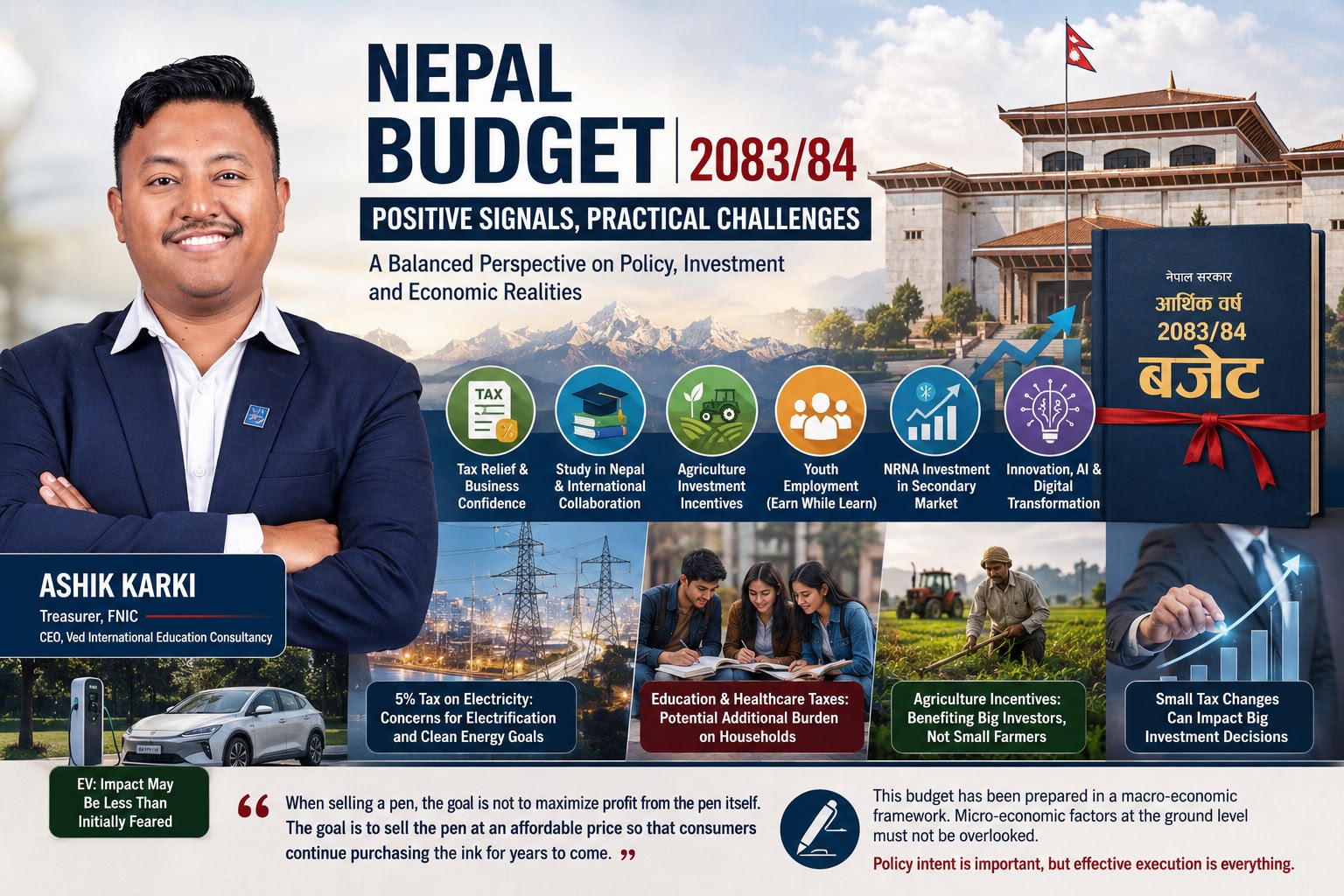
The increase in tax exemptions and the reduction of the highest personal income tax rate from 39 percent to 29 percent send a strong signal that the government wants to encourage consumption, savings, and investment.
Such measures can increase disposable income, improve investor confidence, and support economic activity at a time when Nepal’s economy is still recovering from prolonged periods of sluggish growth.
Similarly, the introduction of a Tax Dispute Settlement Scheme could help reduce uncertainty and improve the business environment by resolving long-standing tax disputes.
The decision to allow Non-Resident Nepalis (NRNs) to participate in Nepal’s secondary share market is another welcome step toward attracting diaspora capital and increasing market liquidity.
Study in Nepal: A Long-Term Strategic Opportunity
As someone actively involved in the education sector, I view the government’s commitment toward the Study in Nepal Initiative as one of the most promising aspects of this budget.
The provision allowing collaboration with foreign universities and facilitating international campuses in Nepal has the potential to transform Nepal’s higher education landscape.
Nepal possesses several natural advantages:
- Affordable education
- Cultural diversity
- Safe and peaceful environment
- Unique opportunities in Buddhism and Yoga
- Himalayan and environmental studies
- Adventure and experiential learning
If implemented effectively, Nepal can position itself as a niche education destination within South Asia and attract international students who seek quality education at a competitive cost.
The opportunity exists. The challenge, as always, is implementation.
Agriculture Incentives: Good for Investors, Less So for Farmers
One of the most discussed provisions in the budget is the government’s support framework for agricultural investment.
Under the announced policy, an investment of approximately NPR 2 crore in agriculture can qualify for support equivalent to 40 percent over four years.
Viewed practically, this translates to an annual support benefit of around 10 percent.
Considering that many investors can currently access financing at interest rates of approximately 6 to 7 percent, the scheme potentially creates an additional margin of 3 to 4 percent annually, making commercial agricultural investment increasingly attractive.
This is undoubtedly positive for:
- Agribusiness companies
- Commercial farms
- Institutional investors
- Organized agricultural enterprises
- Large-scale entrepreneurs
However, there is another side to the story.
The majority of Nepal’s farmers do not operate at this scale.
A small farmer cultivating a few ropanis of land is unlikely to have access to NPR 2 crore in investment capital, sophisticated business plans, professional management systems, or structured financing.
Consequently, this policy appears to favor commercial agriculture and corporate investment more than traditional farming communities.
Those who possess capital, business knowledge, management expertise, and scalable business models are likely to benefit the most.
While commercialization is essential for improving productivity and reducing imports, policymakers must also ensure that small and medium-scale farmers are not left behind.
The Economics of Taxation: A Principle Worth Remembering
One of the most fundamental principles of economics is that price and demand are inversely proportional.
As prices rise, demand generally falls.
As prices fall, demand generally increases.
This principle becomes particularly important when governments impose taxes on sectors they simultaneously seek to promote.
A tax increase that appears minor on paper can have a significant impact on investment decisions.
An investor considering a project worth NPR 5 crore, NPR 10 crore, or NPR 50 crore evaluates every percentage point of cost.
Small increases in taxation can affect:
- Return on Investment (ROI)
- Project viability
- Payback periods
- Investor confidence
- Future expansion decisions
Investment decisions are driven not only by financial calculations but also by sentiment and confidence.
When costs rise, enthusiasm often declines.
Therefore, taxation policy should balance immediate revenue needs with long-term investment objectives.
Concerns Regarding Electricity, Education and Healthcare
While the budget contains several business-friendly provisions, some tax measures raise legitimate concerns.
Electricity
The introduction of a 5 percent tax burden related to electricity consumption sends mixed signals at a time when Nepal is encouraging:
- Electric mobility
- Electric cooking
- Industrial electrification
- Increased domestic energy consumption
Higher costs could potentially slow the country’s electrification efforts.
Education
Additional taxation affecting the education sector may ultimately increase educational costs for students and parents.
At a time when Nepal is promoting educational quality and international collaboration, affordability should remain a key policy objective.
Healthcare
Similarly, additional taxation in the healthcare sector may increase the cost of medical services and place additional financial burdens on citizens.
Education and healthcare should not be viewed solely through a revenue-generation lens. They are long-term investments in human capital and national productivity.
Electric Vehicles: The Reality May Be Less Severe
Following the budget announcement, concerns emerged regarding the potential impact on electric vehicles (EVs).
However, a closer look at the market suggests that many of Nepal’s most popular branded EVs—including models such as the BYD Atto 3 and several competing vehicles—largely fall within price segments that appear relatively unaffected by the revised tax structure.
As a result, the impact on mainstream EV adoption may be less severe than initially feared.
The market’s response over the coming months will provide a clearer picture.
Encouraging Focus on AI and Innovation
The budget’s emphasis on Artificial Intelligence (AI), Innovation, Research & Development, and Digital Transformation deserves recognition.
Globally, countries that successfully embrace technological advancement enjoy stronger productivity, competitiveness, and economic growth.
Nepal cannot afford to remain on the sidelines of this transformation.
The government’s recognition of these sectors is therefore encouraging and aligns with global economic trends.
A Macro-Economic Budget That Risks Overlooking Micro-Economic Realities
Perhaps the most important observation about Budget 2083/84 is that it appears to have been designed primarily from a macro-economic perspective.
The budget focuses heavily on:
- Revenue Mobilization
- Fiscal Stability
- Capital Formation
- Investment Promotion
- Employment Generation
- Private Sector Growth
These are undoubtedly important national priorities.
However, when policy is designed largely through a macro-economic lens, there is always a risk that certain micro-economic realities faced by ordinary citizens may receive less attention.
The challenges faced by:
- Small businesses
- Small farmers
- Students
- Households
Consumers are often different from those reflected in national economic indicators.
A successful economy is not measured solely by revenue collection or GDP growth. It is also measured by how ordinary citizens experience economic policy in their daily lives.
Final Thoughts
Budget 2083/84 contains many positive policy signals. It reflects meaningful engagement with recommendations from FNIC and the broader private sector and demonstrates the government’s intention to encourage investment, innovation, commercialization, and entrepreneurship.
Many good policies have been continued, and policy continuity itself should not be underestimated.
However, given the political stability enjoyed by the current government, many stakeholders expected a more ambitious and transformational budget capable of creating a stronger economic “wow factor.”
The budget appears more beneficial for organized investors, corporations, and businesses with access to capital and professional management systems than for small farmers and ordinary households. Additional burdens on electricity, education, and healthcare also warrant continued discussion.
A simple business principle offers an interesting lesson for policymakers:
When selling a pen, the objective is not to maximize profit from the pen itself. The objective is to make the pen affordable enough that customers continue buying the ink for years to come.
The same logic applies to economic policy.
Governments should ensure that taxes and regulations do not discourage participation in sectors they seek to promote. Lower barriers often generate broader economic activity, stronger investment, higher demand, and ultimately more sustainable revenue collection.
The policy direction of Budget 2083/84 is largely positive.
The real question is whether implementation will match intention.
Because in Nepal, the difference between a good budget and a successful budget has always been execution.
Policy intent is important. Delivery is everything.
The views expressed are personal and do not necessarily represent the official position of FNIC or any institution associated with the author.